Blog

  • Role of Government According to LLMs

    I have noticed a rise of “identity politics” with people siding with “their people”. I have watched people on both the left and the right advocate positions that seem to violate the spirit of the Declaration of Independence and the Constitution. I would encourage people to take a few minutes and give the following prompt to a couple of LLMs as a small sanity check of the positions the align themselves with

    what are some of the positions of current right wing republicans and of the “progressives” which are out of spirit with the visions of government found in the Declaration of Independence and the US constitution?

    While I don’t 100% agree with “answers” provided by the LLMs, I found them worthy of consideration, not something to be immediately discarded. I long for the days where people were not so wed to identity politics, and engaged in thoughtful discussions about policy, if not reasoning from first principles.

    [toc]

    Government through a Biblical Lens

    Many years ago I took a class which was about the philosophy of government which required us to write a paper which summarized our personal philosophy of government based on what we learned in the class and from our personal experience.  As a new Christian I used the issues identified by the great political philosophers combined with major themes in the Bible to construct my paper. One of these days I will pull the paper out from my archives and post it.

    This morning I decided to ask several LLMs (DeepSeek, Grok, Chat-GPT, Llama, and Claude) to perform a similar task.

    I started with asking for a Biblical viewpoint of government, since that is what I tried to capture in the paper I wrote.  I didn’t ask it to explicitly use major political philosopher’s thinking, but I expected issues they raised would influence how the LLM responded. I provided the following prompt.  The responses were similar across all the LLMs.  Below is the response from Chat-GPT 4.5 which was most complete 

    According to the Bible, in recognizing the New Testament takes priority over the old testament, and that much of the Bible is a description of what happened, not what should be….

    Is there a form of government that is better than other models? What is the role of government? What are the key principles that a government should embrace? What are the most important things for a government to do? What is a list of things that the government should not do?

    What sort of policies and actions would be antithetical to this model of government in other words what is a warning sign that our government is moving in a direction that God would not desire

    Taking the New Testament as primary and recognizing that much of Scripture is descriptive rather than prescriptive, we can still extract a biblical vision of what good governance should look like—especially when filtered through the teachings and priorities of Jesus. Here’s a structured framework for understanding government through that lens:

    Is there a form of government better than other models?

    Biblically, there is no single mandated form (monarchy, democracy, etc.). However:

    • Servant leadership (Matt 20:25–28) is consistently affirmed as the ideal posture for leaders.
    • Governments that protect the vulnerable, promote justice, and allow freedom for righteousness to flourish are more aligned with biblical values.
    • Democratic republics with checks and balances, rule of law, and accountability structures tend to reflect the New Testament vision of humility, mutual submission, and community responsibility better than authoritarian models.

    What is the role of government?

    Romans 13:1–7 and 1 Peter 2:13–17 are central texts. Key roles include:

    • Promote justice – punish evil and commend what is good.
    • Protect the vulnerable – reflect God’s special concern for the poor, the stranger, the orphan, and the widow (Isaiah 1:17, James 1:27).
    • Maintain order – enabling peaceable life so the gospel and human flourishing can proceed (1 Tim 2:1–4).
    • Restrain evil – not by controlling hearts but limiting harmful actions.

    The government is a servant, not a savior. It should create the conditions where virtue can thrive, but it cannot impose virtue.

    What are the key principles a government should embrace?

    • Justice (Micah 6:8) – ensuring fair treatment and equity under the law.
    • Humility and Service (Mark 10:42–45) – rulers serve the people, not vice versa.
    • Accountability – leaders are stewards, not owners (Luke 12:48).
    • Freedom of conscience – essential to allow genuine faith and moral agency (Romans 14).
    • Protection of the weak – reflecting God’s concern for the marginalized.
    • Peace and order – promoting public tranquility and cooperation (1 Tim 2:1–2).
    • Limited power – not attempting to take over God’s role in people’s lives.

    What are the most important things for a government to do?

    • Uphold justice and the rule of law fairly and impartially.
    • Protect citizens from violence and coercion (both internal and external).
    • Preserve freedoms necessary for worship, speech, association, and family.
    • Enable economic and social structures that allow people to flourish.
    • Ensure basic infrastructure that serves the common good.
    • Create space for communities, including churches, to thrive and serve.
    • Resist favoritism or oppression, especially for the sake of the powerful.

    What should a government not do?

    • Force religious belief or practice – faith must be free (Matthew 22:21).
    • Suppress conscience – respect moral agency under God.
    • Seek total control over people’s lives – avoid idolatrous claims to sovereignty (Rev 13).
    • Exploit or oppress for the benefit of elites (Isaiah 10:1–2).
    • Confuse itself with God – governments are temporal, fallible, and accountable.
    • Encourage division or injustice – which sows societal chaos and resentment.
    • Pursue empire or domination rather than justice and peace.

    That’s a deep and essential question. When a government begins to drift away from God’s design—as modeled by Jesus and the New Testament call to justice, humility, and service—there are clear warning signs that can help God’s people discern the times. These warning signs emerge from Scripture’s consistent themes and the lived wisdom of history.

    Warning Signs: When a Government Moves Away from God’s Desire

    Here are key policy trends, attitudes, and actions that are antithetical to the biblical model of government:

    • Suppression of Conscience and Religious Liberty
      • Red Flags:
        • Criminalizing or penalizing peaceful religious expression.
        • Forcing participation in actions that violate moral convictions.
        • Government setting itself up as the moral authority over individual faith.
      • Why It Matters: God grants conscience and calls for faith freely chosen (Romans 14, Acts 5:29, Matt 22:21).
    • Use of Power for Self-Preservation or Domination
      • Red Flags:
        • Leaders enriching themselves or clinging to power unjustly.
        • Intimidation, propaganda, or violent suppression of opposition.
        • Lack of accountability or transparency.
      • Why It Matters: Jesus warned against rulers who “lord it over” others (Mark 10:42–45). Government is to serve, not rule with fear.
    • Favoritism Toward the Rich and Powerful
      • Red Flags:
        • Policies that protect corporations or elites at the expense of the poor.
        • Unequal access to justice, education, or housing.
        • Tax or legal structures that entrench inequality.
      • Why It Matters: God condemns “those who make unjust laws… to deny justice to the oppressed” (Isaiah 10:1–2; James 2:1–9).
    • Marginalization or Dehumanization of Groups
      • Red Flags:
        • Nationalism that devalues immigrants or minorities.
        • Language that paints some people as “less than” or dangerous.
        • Policies designed to exclude rather than restore.
      • Why It Matters: All are made in God’s image; Jesus ministered to Samaritans, Gentiles, and outcasts (Luke 10:25–37, John 4, Galatians 3:28).
    • Erosion of Truth and Prophetic Voices
      • Red Flags:
        • Normalizing lies, manipulation, or spin in public discourse.
        • Silencing journalists, whistleblowers, or prophetic voices.
        • Replacing truth with tribal loyalty.
      • Why It Matters: God desires truth in the inward parts (Psalm 51:6); prophets were often unpopular truth-tellers (Jeremiah, Amos).
    • Centralization of Power and Undermining of Institutions
      • Red Flags:
        • Dismissing courts, legislatures, or electoral processes as “rigged.”
        • Seeking unchecked executive power.
        • Rewriting laws to consolidate authority.
      • Why It Matters: Power should be shared and limited to prevent idolatry of the state (Deut 17:14–20; Revelation 13).
    • Culture of Fear, Not Love
      • Red Flags:
        • Policies fueled by fear of the “other” rather than love of neighbor.
        • Justifying cruelty “for our safety.”
        • Political rhetoric designed to divide.
      • Why It Matters: Perfect love casts out fear (1 John 4:18); fear is a tool of coercion, not the kingdom.
    • Neglect of the Poor, Sick, and Imprisoned
      • Red Flags:
        • Cuts to social support while increasing military or corporate budgets.
        • Ignoring prison reform or healthcare for the vulnerable.
        • Lack of concern for those at the margins.
      • Why It Matters: Jesus identifies with “the least of these” (Matt 25:31–46). To neglect them is to neglect Him.

    Summary Table: Godly vs. Godless Government Tendencies

    God-Desiring GovernmentGod-Defying Drift
    Serves all citizens humblyProtects the powerfu
    Promotes truth, justice, and mercyEmbraces propaganda, injustice, and cruelty
    Protects conscience and freedomControls thought, punishes dissent
    Limits power, encourages accountabilityCentralizes authority, suppresses scrutiny
    Uplifts the vulnerableAbandons the poor and outcast
    Welcomes the strangerScapegoats outsiders
    Encourages peace and orderSows fear, violence, and division

    Greatest Political Philosopher?

    I was curious what would happen if I explicitly removed the Biblical lens.  I found that with several of the systems my questions about a Biblical framework seemed to bias the answers I got. To address this, I logged in to the system using different credentials, and then provided the following prompt

    who are the greatest political philosophers from the world, what are the key themes.

    The answers varied a bit, but all included Plato, Aristotle, Hobbes, Locke, Rousseau, Kant, Mill.  There were a number of people who showed up frequently but not universally: Aquinas, Machiavelli, Marx, Hayek, Rawls and Nozick.

    This list it’s nearly identical to the “political philosophy reader” for my political philosophy class. This suggests that the training data for the LLMs I queried is highly influenced by material “from the west”.

    When I explicitly asked for non western  philosophers, deepseek gave me Chinese: Confucius, Mencius, Xunzi, Feizi, Laozi… but not Mao. Indian: Kautilya (Chanakya), Shanti Parva (Mahabharata). Islamic: Al-Farabi, Ibn Rushd, Ibn Khaldu, Ayatollah Khomeini.  African: Ubuntu (culture not thinker), Kwame Nkrumah, Amilcar Cabral. Indigenous Traditions: Haudenosaunee (Iroquois),  Great Law of Peace, Māori tikanga (New Zealand)

    Political Philosophers Synthesis

    I provided the following prompt to each of the LLMs

    Synthesis the greatest political philosopher’s insights as to what an ideal government would look like.

    Is there a form of government that is better than other models? What is the role of government? What are the key principles that a government should embrace? What are the most important things for a government to do? What is a list of things that the government should not do?

    What sort of policies and actions would be antithetical to this model of government

    I am not going to include the responses in this post… it’s already too long.  I would encourage the reader to explore these ideas with the LLM of their choice.

    There was a high degree of overlap between the Biblical,  “Western”, and “Global” to the role of government, what a government should, and shouldn’t do. Key principles had overlap but differed in the basis of the key principles. I found it interesting that the “Global” brought in the concerns of social cohesion, an emphasis of meritocracy/moral excellence of their leaders, and highlighted communal responsibilities of the citizens. 
  • Committed to Grace

    I noted in my post about church essentials that God’s love and grace is the heart of a healthy church. Churches centered on God’s love presence invite members to be gracious, humble, welcoming and compassionate. Ironically, as churches get serious about following their Lord, something often goes wrong.  While a church continue to talk about “grace” and to teach and proclaim “the gospel”, their conduct and attitudes seem more like the Pharisees than Jesus.  The people become “religious” and are often characterized by legalism, pride, exclusion, and judgement. The question I have been wresting with is how does one encourage people to be committed to following the way of Jesus, without becoming religious.

    [toc]

    On an individual level the secret to being committed and grace filled is keeping in mind what we are committed to, or should I say “who”… Jesus. The “commitment” is to have a vital relationship with our Lord. If we are moment by moment in communion with our Lord, if we are seeing the world through His eyes, we will slowly be more or more like our Lord. We will become more and more like Him, and start to do the things He would do if he was in our context. Of course this is easy to say, and hard to live out.

    Man’s original and repeated sin is to be independent, to say “I have got this”. The more mature we think we are, the more practices and systems we devise, the more we are inclined to just go out and “do it” rather than to be in close communion with our Lord. We rely on our experience, knowledge, and wisdom. The people I have met who seem most transformed by Jesus see themselves and beginners, expecting to regularly need correction. A friend wisely told me “The sign of maturity is not the lack of sin because in this life you will never be free of sin, but how quickly you return to the throne of grace”

    Christian communities form as people respond to God’s amazing love and join together in celebration and worship. As members mature they look for ways to encourage each other. Having a set of shared vision with common values and practices is immensely powerful. Together these lead to group identity. As is often noted: individual choices < habits < identity

    Communities implicitly if not explicitly select a shared set of practices which makes them distinct. Typically these are traits of the most respected members of the community. Sometimes it’s the result of careful examination leading to something the book Practicing the Way describes as a rule of life.

    These practices can be good, worthy of engaging in… but they can often turn into a religious activity that produces exactly the opposite of what our Lord would desire. The question is how can we purposely pursue life with our Lord as a community without falling into this trap?

    Some ideas that have bouncing around in my head but I haven’t been able to turn them into a clean and concise post:

    • Everyone is welcome. No conditions or expectations on people. Response to people in curiosity and welcome.
    • Timing is in God’s hand. People are never rushed or pushed. It’s ok to challenge people but never demand or be conditional.
    • Commitment is to follow Jesus, not to do what the community wants
    • Community trusts God to provide… don’t need to pressure people to keep their commitments
    • God reveals Himself to everyone. Everyone has something to share (Parker Palmer model of knowing)
    • Goal is God being magnified… people seeing his love and beauty, not our church growing (though it will typically grow when God is at the center).
    • Seasons… things change, it’s ok if one thing ends because God is starting new things elsewhere
    • Anytime you have a goal and you are measuring KPI, always ask how can that lean in a wrong direction and measure those unintended consequences to know when you are off track.

    I really wanted to post something about this topic. Since my thoughts are still jumbled I decided to cheat. Here are a series of interactions with chat-gpt. In the future I hope my thoughts will become clear and concise enough to remove the chat-gpt text and replace it with what I write. Section headings are my prompts. Subheadings and text from chat-gpt.

    How did the early church avoid become religious (like Pharisees) as they instituted a rule of life

    You’re touching on something profoundly human and spiritually difficult: how to build something beautiful and focused without becoming proud, insular, or unwelcoming. Here’s a way to think about it, rooted in the wisdom of the Desert Fathers, early church, and practical spiritual leadership:

    Hold the Mission with Clarity, and the People with Gentleness

    A healthy mission needs people who are all-in. But that clarity of mission must be paired with a generosity of spirit. The tension is real—but it’s also sacred.

    “If you want to gather honey, don’t kick over the beehive.” – Dale Carnegie (surprisingly relevant here)

    Invite people into belonging before demanding full commitment. Let them taste the beauty of the community and the mission before they take on its full weight.

    Create “Inner Rings” Without Walls

    Instead of “in” vs. “out,” think of layers:

    • The core: those who are fully committed to the rule, rhythm, and mission.
    • The engaged: those exploring, showing up, trying to understand.
    • The curious: drawn but not yet involved.

    The early church did this naturally. Catechumens were people on the way to baptism, fully welcomed in love, but not yet in full sacramental communion. They weren’t judged for it. They were treasured.

    The goal isn’t to lower the bar for commitment—it’s to extend the invitation without pressure.

    Model Vulnerability, Not Superiority

    Pride kills community. But humility opens doors.

    If leaders and core members regularly speak of their own weakness, struggles, and need for grace, it creates an atmosphere where no one feels like they have to “be ready” to belong.

    “Come as you are” only works if those inside admit who they really are too.

    This is what the Desert Fathers did—they never pretended to be holy. They called themselves beginners even after decades.

    Give Space for Slow Conversion

    Jesus didn’t demand everything at once. He walked with people. He let them linger. Even his own disciples took years to understand what he was doing.

    In any mission-driven community, some will need time. Invite them to:

    • Participate in life-giving rhythms (meals, prayer, service)
    • Be loved before being tasked
    • Share voice before making vows

    Rule without relationship leads to rebellion.

    Relationship without rule leads to confusion.

    But relationship with time to grow into the rule? That’s formation.

    See Readiness as a Mystery, Not a Measurement

    Who is “ready” is rarely obvious. Often the loudest, most zealous ones fall away. The quiet, hesitant ones become the faithful core.

    So a wise community:

    • Listens more than it evaluates
    • Prays more than it pressures
    • Walks alongside rather than dragging or excluding

    Think garden, not factory. Let people grow. Water them with presence, patience, and purpose.

    How to Engage in Practices that lead to humble and committed members?

    Here’s a framework you can adapt to your mission-driven community—whether it’s spiritual, creative, justice-focused, or otherwise. The goal: form a community with clear commitment, open doors, and gentle pathways in.

    The Table: Radical Welcome

    Posture: Come and see

    Who it’s for: The curious, exploring, unsure

    Practices:

    • Open gatherings, meals, storytelling
    • No expectations, just invitation
    • Focus on hospitality, beauty, and non-coercive presence

    Message:  “You belong here even before you believe or commit.”

    Desert wisdom echo: The monks welcomed all visitors as Christ. Even those who were skeptical or sinners.

    The Hearth: Shared Life

    Posture: Come and be known

    Who it’s for: Interested and relationally invested

    Practices:

    • Shared practices (simple prayer rhythms, meals, serving)
    • Gentle exposure to the rule of life
    • Safe spaces for questions and real conversation
    • No pressure, just proximity

    Message:  “You matter. Your story matters. Let’s walk together awhile.”

    Why this matters: This is where the seed of commitment starts to grow. Think belonging before believing, believing before behaving.

    The Workshop: Gentle Practice

    Posture: Come and be shaped

    Who it’s for: Ready to grow, but still forming

    Practices:

    • Intro-level commitments (partial rule, spiritual guidance, regular rhythm)
    • Shared projects that matter
    • Mentoring, not managing
    • Failures treated as normal and expected

    Message:  “You don’t have to be perfect—just willing.”

    This is like a catechumenate. It’s where the rule of life becomes invitation, not obligation.

    The Circle: Covenant Community

    Posture: Come and commit

    Who it’s for: Those who’ve discerned a call to shared life and responsibility

    Practices:

    • Full rule of life
    • Mutual accountability (gracious, not rigid)
    • Discernment in community
    • Roles of leadership or stewardship

    Message:  “We’re in this for the long haul. Let’s bear the weight together.”

    Important: This isn’t exclusive—it’s simply mature. It exists so the community can last, deepen, and bless others. These are your culture-keepers.

    The Door: Permeable Movement

    At any point, people should be free to move inward or outward through the circles—without shame.

    • Someone may step back for a season of rest or grief.
    • Another might move inward slowly, or jump forward when grace hits.
    • Honor everyone’s pace.

    The key: Clarity without pressure. Invitation without judgment.

    How do good practices lead to a community that is characterized by legalism, pride, exclusion, and judgement?

    This is one of the most important (and heartbreaking) dynamics in spiritual community—and it’s happened over and over again throughout history:

    A community starts with vision, devotion, and simplicity,

    and over time becomes marked by legalism, pride, and exclusion.

    Here’s how and why that shift tends to happen.

    What Begins as a Tool Becomes an Idol

    The rule of life starts as a trellis to help people grow—prayer rhythms, fasting, silence, shared labor. It’s flexible and pastoral.

    But over time, the form can become more important than the fruit. The practices are mistaken for proof of holiness.

    “The Sabbath was made for man, not man for the Sabbath.” — Jesus (Mark 2:27)

    How it happens:

    • Practices become identity markers.
    • People forget why the rule was created in the first place.
    • The rule gets used to measure others, not humble oneself.

    Stability Becomes Rigidity

    Early communities are often dynamic, humble, experimental. But as they grow or institutionalize, they fear losing control. So they tighten the rule.

    How it happens:

    • Structure becomes survival.
    • Leaders react to failure or disorder by doubling down on rules.
    • Adaptability is replaced with gatekeeping.

    “We must protect the mission” becomes a reason to exclude the slow, messy, or broken.

    Commitment Gets Confused with Superiority

    People who have made serious sacrifices naturally feel invested. But without deep humility, that commitment can morph into pride.

    “I fast twice a week and give a tenth of all I get…” — The Pharisee (Luke 18:12)

    How it happens:

    • The deeply committed forget their own journey.
    • Newcomers are seen as threats or lesser.
    • Instead of inviting, people begin filtering.

    The Fear of Losing “Purity”

    This is a huge one. When a community tastes something beautiful—deep prayer, intimacy with God, close fellowship—there’s often a fear of losing it.

    So what do we do? Build walls. Protect the vibe. Keep “impure” elements out.

    How it happens:

    • Exclusion is framed as “faithfulness.”
    • Difference is seen as danger.
    • Mercy is sacrificed for the sake of “doctrinal” or “cultural” purity.

    Ironically, in trying to preserve the soul of the community, we can kill it.

    Judgment Easier Than Compassion

    When people fall short of the rule—or resist it—it’s easier to judge than to walk with them. Especially when compassion is costly.

    “Why does your teacher eat with tax collectors and sinners?” — The Pharisees (Matthew 9:11)

    How it happens:

    • Rules provide clarity; people are complex.
    • Judging gives a sense of control.
    • Compassion feels inefficient and emotionally exhausting.

    So the “righteous” push the wounded out instead of binding their wounds.

    Summary: A Tragic Drift

    What Starts As…Eventually Becomes…
    A shared rhythm for growthA rigid code for measuring worth
    Commitment to ChristCommitment to community culture
    Loving correctionCold judgment
    Invitation to healingExclusion for imperfection
    Humble sacrificeSpiritual pride

    So, how do we resist this?

    A few enduring practices from the Desert Fathers and others:

    1. Practice daily humility – Confess weakness, not achievement.
    2. Center mercy over rule – Let love guide enforcement.
    3. Adapt the rule to the weak – Just like Jesus did.
    4. Keep telling the origin story – Remember why you began.
    5. Place relationship before regulation – Always.

    What are warning signs that a community is drifting into legalism?

    Think of these like spiritual “check engine lights.” If you see a few of these, it’s time to pause, reflect, and gently course-correct.

    The Rule Becomes the Point

    • People talk more about keeping the practices than why they exist.
    • The original heart (prayer, presence, humility, love) gets lost in talk of “structure” and “discipline.”

    🧠 “We fast on Wednesdays and Fridays.”
    ❤️ “We fast to hunger for God and stand with the poor.

    Flexibility Is Viewed as Compromise

    • Mercy, nuance, and pastoral flexibility are seen as weakness.
    • People fear “watering things down” more than they fear becoming harsh.

    If someone suggests adapting the rule for the wounded or new, the response is:

    “That’s not how we do things here.”

    Spiritual Hierarchies Emerge

    • Those who follow the rule most visibly are subtly (or overtly) elevated.
    • People who struggle feel like second-class citizens—or leave quietly.

    The rule is no longer a trellis; it’s a pedestal.

    Correction Lacks Compassion

    • Confrontation becomes sharp, cold, or public.
    • There’s little space to confess weakness without fear.
    • Accountability feels more like policing than shepherding.

    “We need to protect the standard.”

    becomes a cover for shaming those who fail.

    Judgment Replaces Joy

    • People become more focused on who’s “doing it wrong” than on celebrating what’s good.
    • Critique becomes the dominant mode of communication.
    • Laughter, warmth, and hospitality decrease.

    Legalism kills joy—it replaces gratitude with performance anxiety.

    Insiders Stop Noticing Outsiders

    • There’s little awareness or care for people not yet “inside” the rhythm or culture.
    • Language becomes insider-heavy and unintentionally alienating.
    • The door is still open—but no one’s really holding it.

    “They just don’t get it,” instead of “How can we help them feel welcome and seen?”

    Failure is Seen as a Threat, Not a Grace

    • There’s no space for people to be messy, slow, or inconsistent.
    • Struggles are seen as dangerous, not sacred.
    • The community forgets how much grace they once received.

    The focus shifts from formation to filtering.

    A Healthy Rule of Life Should Always Feel Like:

    • A path, not a pedestal
    • A gift, not a gate
    • A support, not a scoreboard
    • A tutor, not a tyrant
    • A shared meal, not a spiritual test
  • Change the World? Love > Rule

    Jesus never built an empire. He healed the broken, welcomed the outcast, confronted the powerful, and loved the world—without trying to rule it.

    The church as been it’s best when following Jesus’ example. The church has been its worst when it has followed worldly wisdom to accomplish its goals. The contrast couldn’t be more obvious:

    • Cared for the marginalize rather than seeking wealth and power for itself.
    • Engaged in acts of service rather than seeking military, legislative, or economic power to bring about change.
    • Honoring each person’s freedom to believe, inviting people to follow rather than using coercion to bring others into compliance.
    • Treated everyone as a neighbor worthy of love, not being intolerant and establishing an us -vs- them dynamic.

    The Temptation to Rule

    The Son of Man came not to be served, but to serve, and to give his life as a ransom for many. — Mark 10:45

    The desire for control isn’t new temptation for the christians. Jesus’ disciples argued about who would be the greatest (Luke 22:24–27). They expected Jesus to take political power—but he refused it, choosing the cross over the throne.

    The church often slips into power-seeking, confusing dominance with faithfulness which has diluted the church’s witness. Tom Holland’s book Dominion documents several of these moments through history.  To call out a few:

    • Constantine’s conversion (AD 312) gave Christians legal status, which ended persecution—but within decades, the church became entangled with empire.
    • The Crusades (11th–13th centuries) were born from a belief that God’s kingdom could be advanced by force, causing massive harm.
    • The Spanish Inquisition (1478–1834) Under the guise of protecting orthodoxy, the Catholic Church—especially in Spain—used torture, coercion, and execution to force conversions and root out heresy. This abuse of spiritual authority in partnership with the monarchy became a terrifying symbol of religious control.
    • State Churches in Europe After the Reformation, many Protestant nations established state churches (e.g., Church of England, Lutheran state churches in Scandinavia), where citizenship and church membership were linked. This often led to forced baptisms, religious conformity, and persecution of dissenters—blending national identity with Christian faith in a way that eroded both.
    • In the colonial era, missionary efforts were too often fused with conquest, leading to cultural erasure and exploitation.

    Tim Alberta’s book  The Kingdom, The Power, and The Glory describes how the modern evangelical church has made the same error.

    What Real Change Looks Like

    He has anointed me to proclaim good news to the poor… — Luke 4:18

    Jesus changed the world without armies or policies. He loved people. Told stories. Restored dignity. He lifted the lowly and called the powerful to repentance.

    The early church followed his way:

    • In Acts 2–4, believers shared everything in common, ensuring no one was in need.
    • The early church cared for widows and orphans, risking their lives during plagues to tend to the sick—often when even pagan physicians fled.
    • Their radical love and nonviolence led Tertullian to write: “See how they love one another!”

    In three centuries, the followers of Jesus went from a persecuted minority to a dominion force. What is truly striking is not its rise to power, but how it radically transformed cultural norms. This was not accomplished by instituting policies but by their example. Before the christians came onto the scene, greek and roman culture didn’t have the concept of caring for the marginalized or recognizing inherent human rights. These ideas, now taken for granted, were revolutionary—and rooted in Jesus’ example.

    Real change comes not through legislation, conquest or empires, but through acts of love and faithfulness, from compassion.

    Love Over Leverage

    God’s kindness leads us to repentance. — Romans 2:4
    Let all that you do be done in love. — 1 Corinthians 16:14
    Let your light shine… that they may see your good deeds. — Matthew 5:16

    Power pressures and manipulates. Love transforms. Jesus loved people before demanding change. Jesus didn’t coerce belief. He invited people into truth. He loved before they repented (Luke 19:1–10). He offered healing before demanding loyalty. Leverage might win a battle—but love wins hearts.

    The most powerful message is a life of quiet, consistent service.  A few examples of people whose lives illustrate this:

    • St. Francis of Assisi gave up wealth to live among the poor, care for lepers, and embody the simplicity and peace of Christ
    • Elizabeth Fry who reformed prison conditions in England through consistent, compassionate presence.
    • George Müller cared for thousands of orphans in England through prayer, faith, and quiet perseverance—never asking directly for funds.
    • Mother Teresa built trust and influence by simply serving the most forgotten.
    • Dorothy Day practiced gospel-centered hospitality among the poor during the Great Depression
    • John Perkins who worked for reconciliation, education, and racial justice

    A Different Kind of Influence

    Do not conform… but be transformed. — Romans 12:2
    Act justly, love mercy, and walk humbly.— Micah 6

    We’re not called to rule the world. We’re called to love it—faithfully, humbly, and fearlessly.  That’s how we really change it. Christians are called to reflect a kingdom not of this world. The church doesn’t need more power. It needs more presence.

    • Be a creative minority — distinct, faithful, hopeful
    • Invest locally — serve neighbors, build trust
    • Influence by embodied example, not loud opinion 

    Related

  • Seeing People

    How we see people has a huge impact on how we interact with them. If you expect the worst from someone, that’s what you will see and you will be tempted to treat them with contempt. If you expect the best of someone, you will tend to engage with empathy and connections.

    This post was prompted by a conversation with a good friend this morning. He was feeling drained from conversations with hateful people, and honestly, I understood. I’ve felt that same fatigue and frustration. But instead of offering him the empathy he needed, I jumped too quickly to a “solution.” Still, beneath my response, I believe there is a truth that has the power to transform how we experience others.

    We were made in the image of God. Then we turned away from Him—breaking His heart, our own character, and the world around us. And yet, even in the brokenness, remnants of that original beauty remain.

    A cracked mirror still reflects. In the same way, flawed people still reflect the glory of God. My dear friend Lynne Fox often reminds me that there is no such thing as pure evil—only the corruption of something originally good. When we learn to recognize that glimmer of God’s image in others—the divine spark, if you will—it changes everything. I believe this is one of the great secrets to truly living into the Kingdom of God, this enables people to experience the Camino spirit.

    Jesus saw the fractured reflection of God in people. You can see it in his compassion, in how he responded to the broken, the outcast, the sinner. He saw what they could be, not just what they were.

    Many great spiritual leaders have shared this way of seeing. Mother Teresa, inspired by Matthew 25:40, wrote:

    We try to pray through our work by doing it with Jesus, for Jesus, to Jesus. That’s why we are able to see Him in the broken body, in the abandoned child, in the hungry man. Each one of them is Jesus in disguise.

    C.S. Lewis explored this idea in The Weight of Glory. Thomas Merton reportedly experienced a moment of clarity in which he saw people in their true, radiant dignity. The book Abandon to God recounts how Oswald Chambers had an extraordinary ability to be fully present with others—I wonder if that was because he saw God in each person, recognizing that God was right there in the moment.

    I have found that when I intentionally look for God’s image in people, I can find it. And when I do, my interactions shift. Conversations become richer, relationships more meaningful. But if I’m not looking for the good, it’s all too easy to focus on flaws, to be irritated, disappointed, or even cynical.

    I know I’m only scratching the surface here, and I want to explore this further. But even if this thought is incomplete, it feels too important to delay sharing.

    Related

  • Scratch

    Scratch is a one of the best languages to learn how to program computers. The language is easy to learn while being surprisingly powerful. Often I meet students who want to learn how to create web sites or applications. They want to immediately learn Python, C#, or other other “practical” programming languages. My recommendation is to first learn programming basics using Scratch and then learn other languages like Python. Scratch lets you focus on learning the most critical skills. Often it is faster for a novice programmer to gain mastery by learning Scratch and then “a practical language” than to start with the language they ultimately want to use.

    [toc]

    This post was inspired by meeting the teachers and students at Achungo. A WhatsApp Group for teachers and students interested in Scratch@Achungo.

    I will be adding more to this page in the near future.

    Getting Scratch

    If you have a browser that was updated in the last year and an Internet connection, just click the “Create” button on the Scratch home page and you are ready to go. If Internet access is spotty or you are using an old browser you can download offline scratch for Macintosh, Windows, Chromebooks still under support, and Android powered devices. On Macintoshes you can also download scratch through the App Store.

    The current version of Scratch does not work on older Chromebooks (like HP Chromebook Pavilion 14 at Achungo). I am working to get this fixed. I was hoping to have a copy of Scratch 3 that could be loaded onto an Chromebook by the end of March, but so far, the folks from MIT haven’t been able to get something that works to me. In the mean time, Scratch 1.4 running inside Squeak does work on old Chromebooks. It takes awhile to load, it’s a bit slow, and some of the functions in Scratch version 3 are missing… but you can still write programs and create games in it!! There is a nice textbook about Scratch 1.4 which can be borrowed for free from archive.org. Here is the scratch site from 2012 (when Scratch was at version 1.4). Have fun.

    Newer iPads can run Scratch in the Browser. There seems to be a full version Scratch in Chinese but it will be challenging to use by people who can’t read Chinese. There is a ScratchJr app which can run on iPads but it is missing most of the features of full Scratch. I will update this section if/when I find an English version of Scratch as an App for the iPad.

    Scratch Tutorial Coding Game in the Macintosh App Store is a free + pay for additional features app which walks a student through the creation of games in a very easy to follow way. Warning: sometimes it is a bit buggy and you might have to restart the lesson.

    Getting Started

    I would recommend exploring scratch.mit.edu which has links to many resources. Some good courses that use Scratch:

    • Harvard’s Creative Computing Curriculum: Curriculum including workbooks, resources, notes for classes to use Scratch to learn to think computationally.
    • Harvard CS50 Scratch Module: Harvard CS50 is one of the best college level introductions to computer science. Once the basic have been mastered using Scratch, the class using C and Python.

    Kenya has produced textbooks about programming scratch for grades 5-9 as well as training material for teachers.

    Games

    Games are fun to play, and can inspire creativity by providing ideas of things to build. There are many excellent games that have been created using Scratch. Not only can you play these games, but if you click the “See Inside” button you get to see the code which makes the game work.

    Going Further

    You will not be able to create cool games or really complex applications immediately. You will have to start with simpler programs and work your way up. There are skills that you will need to develop through practice. Often this practice can be boring… but it’s necessary, and will be worth the time you spend learning and practicing.

    Once you have mastered the basics in Scratch a good second step is learning the material covered by the AP CS Principles Curriculum. In the spirit of Scratch is the language Snap and the excellent Beauty and Joy of Computing which covers the AP CS Principles Curriculum.

    How to go from writing simple games in Scratch or Snap to being a software engineer who could work for companies like Google and Apple?

    It is said that it takes 10,000 hours of practice to master a discipline. That’s 4 hours / day for 7 years. This can be seen in elite athletics who win in the olympics or play for professional teams as well as great scientists and doctors. They constantly learn and train to become the best. Practice is also needed to become a great programmer.

    COMMON SOON: Next steps in mastering programming and becoming a software engineer.

    There is a close relationship between thinking well, problem solving, and programming. Working hard at school, especially math and science will help you become a good programmer.

    Where did Scratch Come From?

    In the 1960s there was some amazing work done by a team of people at MIT led by Seymour Papert. They used computers as a tool for students to explore and learn rather than merely an automated tool for rout memorization or for teaching computer science.  The book Mindstorms described some of their work. The Logo programming language and “turtle graphics” were two of the technologies that were invented by this team. This work has inspired many other projects. In the 1970s a group of people at the legendary Xerox Palo Alto Research Center (PARC) created Smalltalk as an environment for children to learn and program. This simple language grew into one of the most advanced programming environment used by professional programmers. Years later a free version of Smalltalk called Squeak became a beloved environment for kids and professionals alike. Several members of MIT Media Lab’s Lifelong Kindergarten wanted something a bit easier to learn than Squeak. They invented Scratch which was initially a program running inside Squeak. The current version 3 of Scratch no longer depends on Squeak. The paper Scratch: Programming for Everyone explains what the creators of Scratch hoped to accomplish.

    See Also

  • Wealth

    Most people in the developed world have no idea how wealthy we are when compared to the sweep of human history. Even when people know this, it’s easy to take what we have for granted, and to forget to be thankful for the lives we are able to lead. I oscillated between feeling deep gratitude and contentment for my life situation, worrying about whether I will be able to maintain what I have as the world changes around me, and occasionally feeling dissatisfied with what I have and desiring more?! I wrote this post as a reminder to myself, I hope it might be useful to others as well.

    [toc]

    By all measures I am wealthy. I worked hard for what I have, but I recognized that grace (some might say luck) has played a substantial role in where I am today. I know that I have won the geographic, genetic, and “era” lotteries. I strive to keep perspective. One thing I have found helpful is to engage in the practices of gratitude and generosity. These help keep me grounded and reduces my tendency to let my wealth draw me away from dependence on God. It is said that we often value the gifts we receive more than the giver, who is the real prize. I often fall into this mindset, and then I wake up and realize nothing better than when I clearly see, feel, and experience God’s uncoditional love. Life is best when God’s love fills my heart and drives my life.

    What is Wealth?

    First, I would like to draw a distinction between “rich” and “wealth”. The term “rich” is typically focused on  income and consumption.

    Wealth is a holistic term. Salih Bloom in the book The 5 Types of Wealth: A Transformative Guide to Design Your Dream Life  notes while most people equate wealth with their financial state, there are four other ways we can be “wealthy”

    • Financial: Not lacking material needs
    • Time: Spend time on what we desire.
    • Social: Engage with people and activities as we desire.
    • Mental: Not pressed down by trauma or fear.
    • Physical (Health): Robust health and access to treatments when facing injury or disease.

    There is no universal definition of what it means to be “wealthy” because the concept is highly subjective and circumstantial, and shaped by cultural, social, and personal factors.  It is possible to talk objectively about someone’s relative wealth, but most people experience wealth subjectively. For these people, wealth may be best defined not by how much they have, but by how much they feel is enough to live the life they desire.

    Compared to What?

    Most people who are wealthy when compared to the majority of humanity don’t consider themselves wealthy. This is because people make comparisons to their “normal” experience.  Much of the time people interact with people who are of similar economic class, so they think of themselves as just average. Second, almost everyone knows someone who has more than they do.  Those are the wealthy people.

    For example, the average salary for a successful software engineer in the Bay Area puts them in the top 1% of the world, 10% in US, 20% in the Bay Area.  But they are making around the same as their coworkers, and  they know celebrated engineers who make three times what they earn each year. They find several of their desires, like purchases a home, out of reach, so they don’t think of themselves as wealthy.

    Era of Wealth

    Extreme poverty, which is experienced by 10% of the current world, was experienced by nearly 80% of the people living in the 1700s!

    The opportunity and material wealth in the 20th and 21st centuries is like nothing man had previously experienced.  People who today are above the worldwide lowest 25% have better lives than the rich a few centuries ago.

    A “middle class life” in the current world, what many people in the US would be considered being at the poverty line, is largely superior to what royalty experienced in the 1700s. We have climate controlled buildings, health care, a huge variety of food and goods of a quality and nature that couldn’t be imagined two hundred years ago. In many countries we have a rule of law so you don’t have to worry that just because someone has more power than you, that they are free to take whatever they want. The ability to travel vast distances safely in hours which enables us to have incredible experiences.

    For more details see the article we live like royalty and don’t know it, which is part of what I hope will be an excellent series How the System Works.

    Geography of Wealth

    The following is mostly for people in “the west”:  US, Canada, Europe.  We have won the geographical lottery. Being a citizen in our country virtually gaurentees that we are well off compare to most people in the world.

    • In the US an income of 35k (which is 90% of the residences of the USA) puts us in the top 10% world wide.
    • An income of 60k, which is what 35% of the US, puts someone in the top 1% of the modern world.
    • An income of 500k puts someone in the top 1% of the US
    • An income of $1M puts someone in the top 1% of the Bay Area.

    Damage of “Comparision” Fueled by Media

    I mark the airing of the TV show Lifestyles of the Rich and Famous hosted  a major turning point. It has been estimated that up to a billion people have been exposed to the shows content: ostentatious spending.

    People who used to consider themselves rich were exposed to extreme wealth for the first time. Envy started to creep in.  This has become even more of a problem with the advent of social media. People who use social media are bombarded with images of people with more than they have… or at least look like they have more. People curate their feeds to highlight their peaks, if not using generative AI to provide a completely false picture.

    I have heard numerous antidotal stories about how access to mass and/or social media moved whole communities from being generally happy and content to unhappy an discontent.

    What We Have is a Gift

    I often hear very successful people tell stories about they are responsible for their success. That they worked harder and smarter than other people. Whether or not this is true, their success also came from “luck” or “grace”. In almost all cases these people had advantages that they take for granted. One has to ask if they were an orphan, born in Sub-Saharan Africa, could they have possible accomplished what they did. Typically the answer is “No”.

    It’s worth remembering the observation “For who sees anything different in you? What do you have that you did not receive? If then you received it, why do you boast as if you did not receive it?”  – 1 Cor 4:7 (ESV)

    I believe the apostle Paul expressed the attitude of contentment that we should strive to adopt

    But godliness with contentment is great gain. For we brought nothing into the world, and we can take nothing out of it. But if we have food and clothing, we will be content with that. – 1 Timothy 6:6-8 (NIV)

    I am not saying this because I am in need, for I have learned to be content whatever the circumstances. I know what it is to be in need, and I know what it is to have plenty. I have learned the secret of being content in any and every situation, whether well fed or hungry, whether living in plenty or in want. I can do all this through him who gives me strength. – Philippians 4:11-13 (NIV)

    True Wealth

    Blessed are you who are poor, for yours is the kingdom of God — Luke 12:32

    Why did Jesus say this? Poverty is in no way “noble”.   Deprivation is not good. The answer can be found in Proverbs 30:8-9

    Keep falsehood and lies far from me; give me neither poverty nor riches, but give me only my daily bread. Otherwise, I may have too much and disown you and say, ‘Who is the Lord?’ Or I may become poor and steal, and so dishonor the name of my God.

    As we accumulate wealth, it becomes easier and easier to “take care of ourselves”. As we do this, we trust in what we have accumulated. Our security comes from our wealth. Wealth often corrupts character as people feel empowered to go the way they want to rather than seeking God.

    Psalms 23 describes how God desires to richly bless us, but we often don’t see what He is doing or believe that He is caring for us. Rather we make our own way and in doing that, settle for what’s second best, a counterfeit of God’s true blessing.

    A Challenging Example

    Years ago I read the biography of George Müller (1805–1898). George had an abiding trust in God and prayer.  He felt called by God to care of orphans. He founded The Ashley Down Orphanage in Bristol, England which cared for over 10,000 orphans during his lifetime. What was remarkable was he never solicited funds but relied entirely on prayer. Needs were met through unsolicited donations, often arriving at the last possible moment. Müller had an extraordinary faith in God’s provision.  Every day he was looking for God to show up, and God did.

    Other People’s Thoughts

  • Computing Memory Lane

    Periodically I get asked questions about computing in the age before Linux, OSX, Microsoft Windows (NT based), Google, Stack Overflow and Chat-GPT/Claude. I encourage people to look at historical systems that can inspire and teach important lessons. The following are sites which are preserving the past. Some of these links are to wikipedia and should be replaced with link to something that tells the story and significance of these systems more effectively. I think it’s amazing that people today can experience what computing was like in the 1970s and 1980s.

    Operating Systems

    • Multicians: Wonderful site providing history of Multics and clear explanation of why Multics matters. Many first. Complete and consistent OS which when first produced was considered “large”, but later was much smaller that many operating systems that followed it. You can run Multics in a simulator on your own machine. Multics simulator on a Raspberry Pi is faster than the original production systems that supported hundreds of simultaneously
      users . 🙂
    • Plan 9: what UNIX would be if taken to it’s logical conclusion. Amazingly powerful and compact. Plan 9 was designed to be used in a distributed environment.
    • KeyKOS a secure capability based system. Nice memorial for Norm Hardys

    Programming Environments (way more than just a programming languages)

    • Smalltalk: amazing, paradigm shattering. See the Smalltalk Zoo for history and some early artifacts you can interact with.
    • Interlisp-D: lovely and rich version of lisp. a revival project to get it running natively on modern systems. It’s possible to run the historical code on emulators… but why bother 🙂

    Hardware Emulators (and software for them)

    Archive Sites

    Videos

    Related

  • Gear 2025

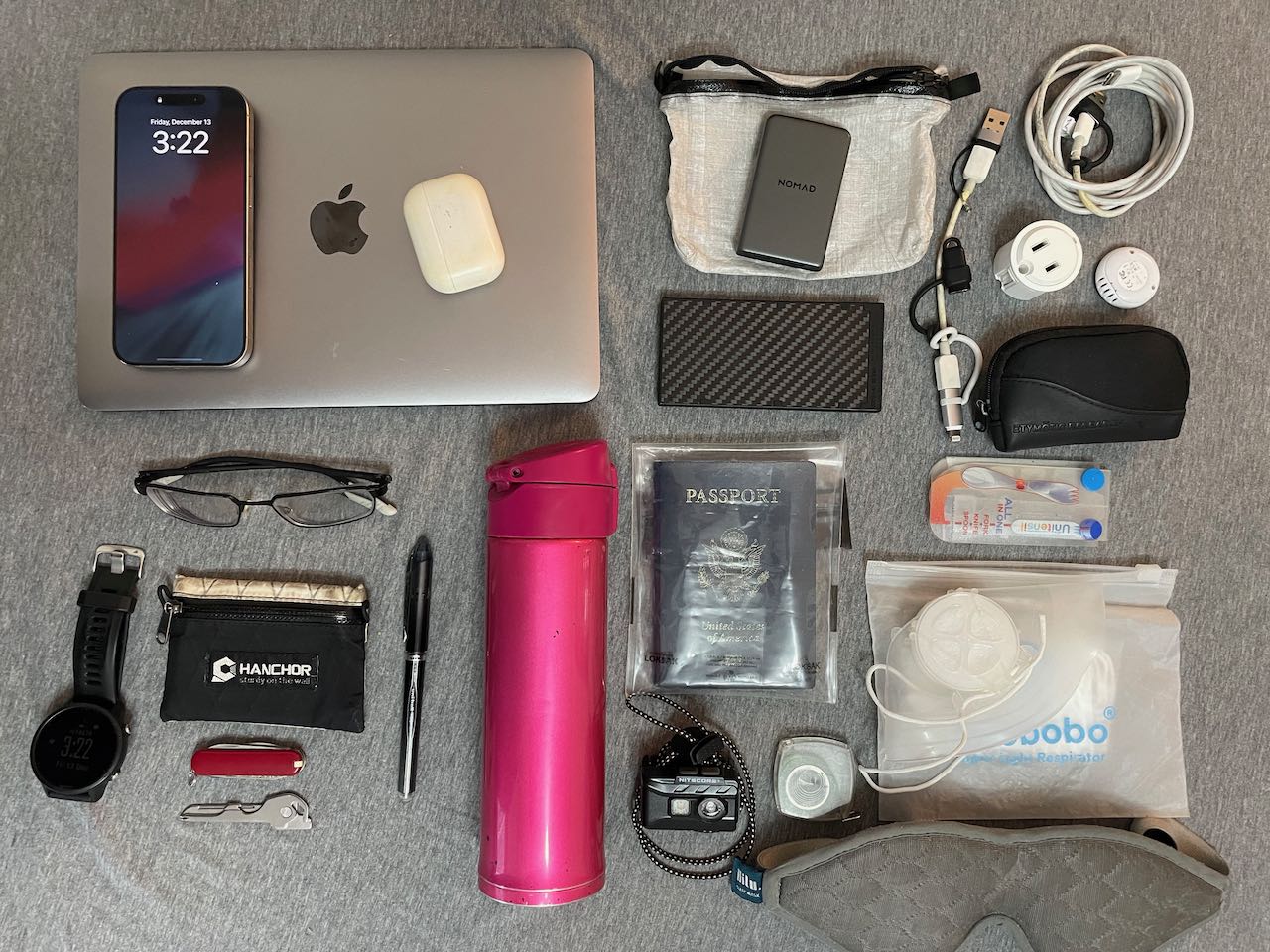
    I have found simplicity to be a useful lens in life. Simplifying my stuff has provided freedom, remove unnecessary friction, while enabling me to pursue what is important to me, aka what I consider a meaningful life. The following is a complete list of everything I own. This list might look minimalist to the average person living in the SF Bay Area, and luxury for people who live in much of the world. Making this list was inspired by zenhabit’s one bag lifestyle and Tynan’s Gear posts. I also have a list of items shared by our family. Please do not allow your possessions to become the basis of your self-worth, security or well being.

    Items in bold are exceptionally great. I happily use items marked with “*” but I would not automatically replace them. If I was a “true minimalist” I would get rid of them. The (year) is when the item became a standard part of my life, /year indicates when I re-purchased.

    [toc]

    Bags

    For the last three years I have been living out of my “bags” as we have continued out semi-nomadic life. We plan to be more settled by the end of this year.

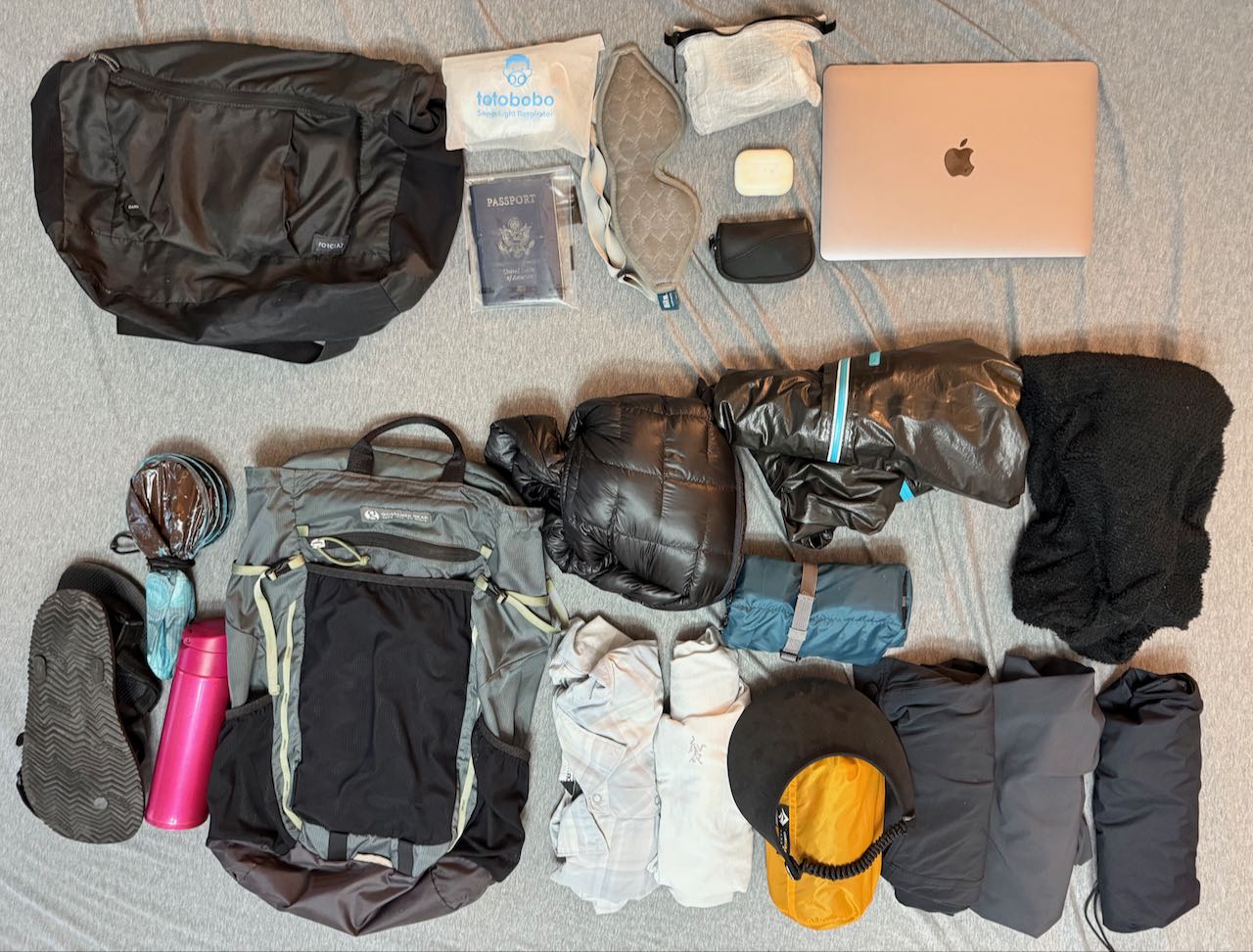
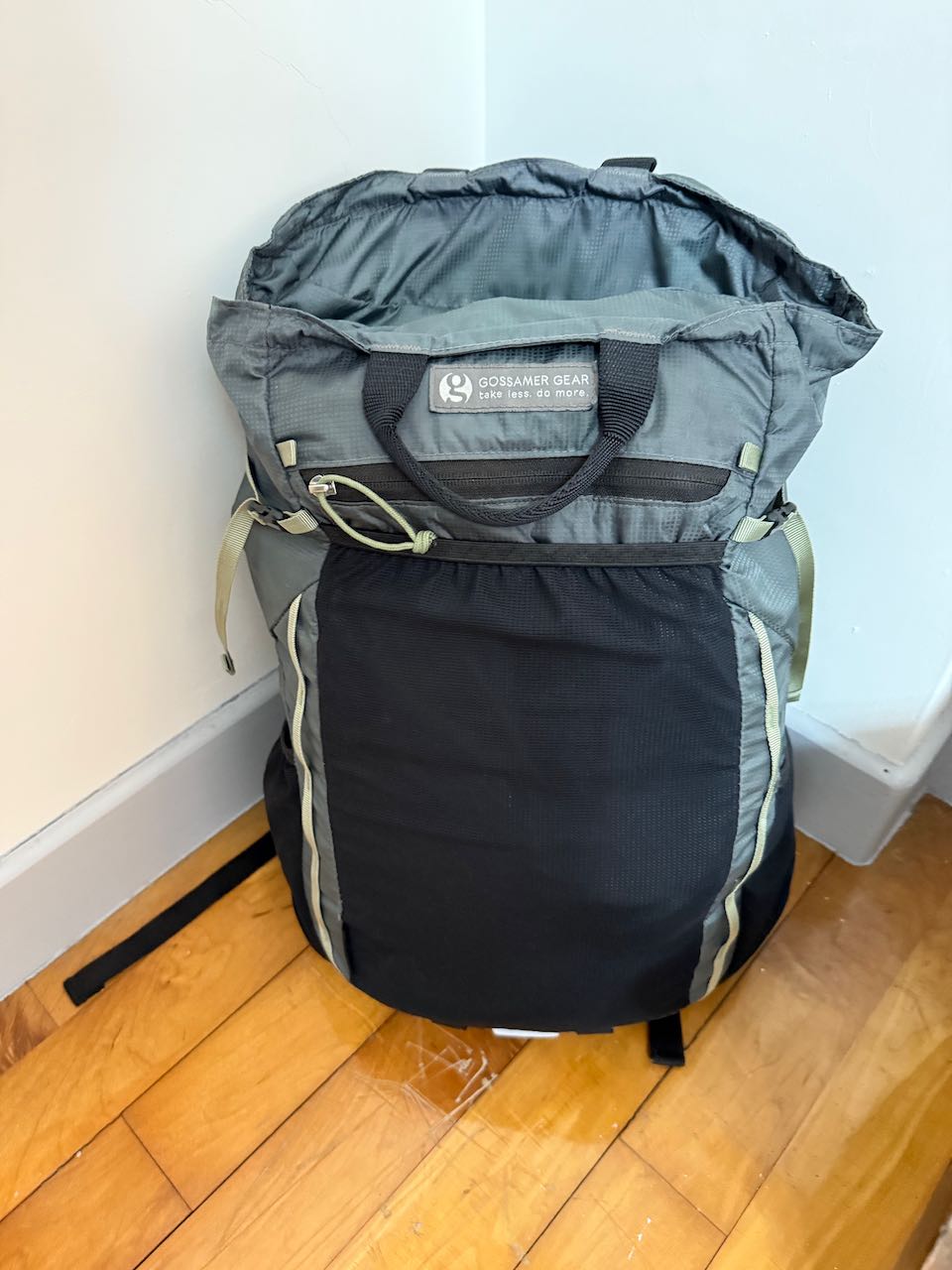
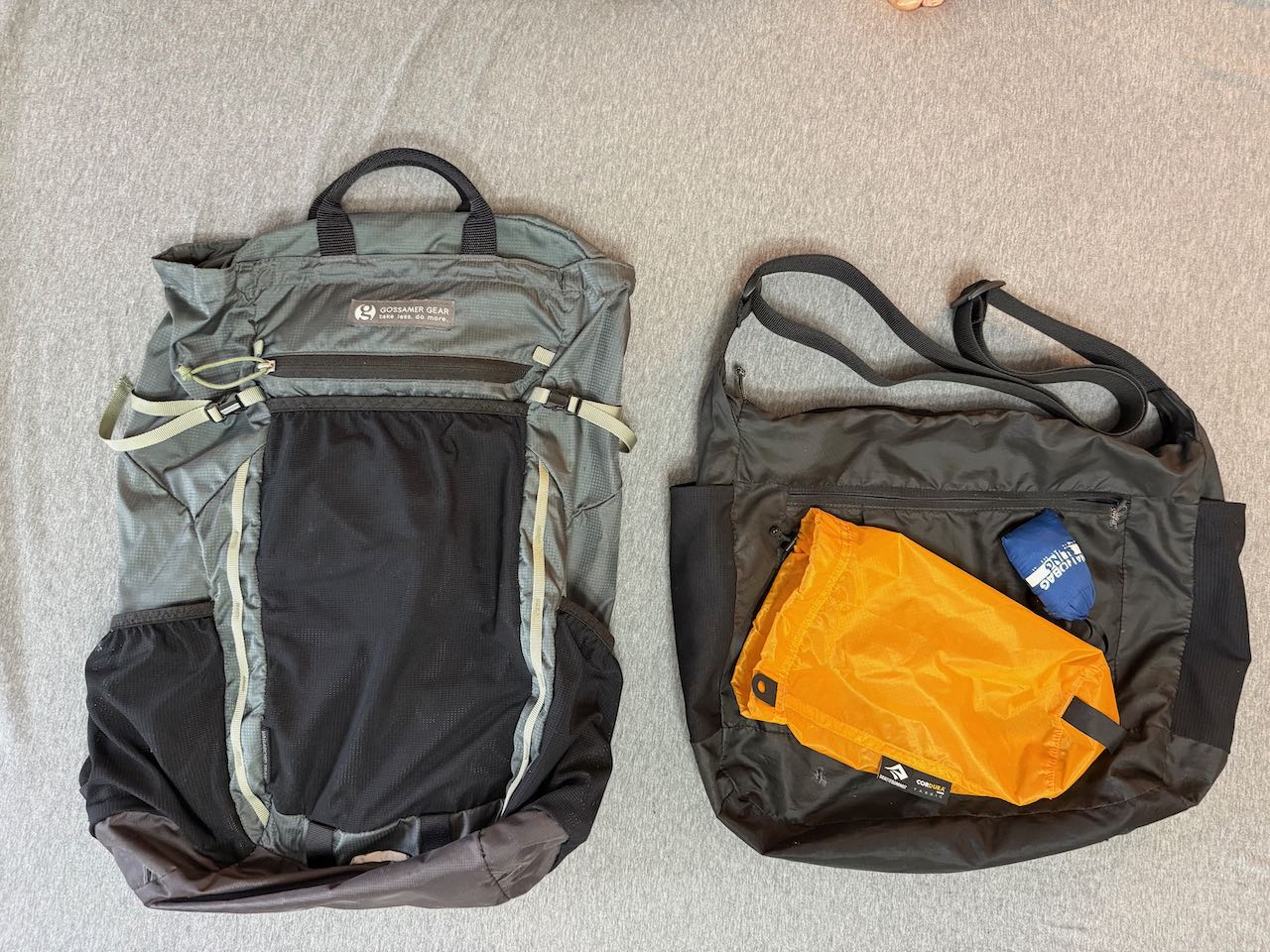
    • Gossamer Gear Vagabondmy review (2022) a 23L day pack which is light weight, comfortable to carry for extended periods of time, works well for EDC, and is large enough to hold everything I take when traveling. 46x27x15cm (18/10.75/5.75inches) filled with my normal gear is small enough to squish into every “personal item” sizer I have encountered and under the seat in front of me. While access is not as easy as a clamshell style bag, I have no problem retrieving items by feel because my clothing and stuff sack have different textures. Stands up on its bottom makes access on the go easy. I am using the discontinued Trail model. The current Jet model has some nice upgrades. I have a list of other travel and trek packs.
    • Decathalon Packable 15L Courier Bag (2023) Used when most of my gear can be left behind. Easier to access on the go than a backpack and no sweaty back. Large enough to hold anything I might need, unstructured so light loads still feels small and can be worn under my slim fitting coat. Carrying >4lbs for an extended time is uncomfortable for my shoulder. The bag has several small holes in the fabric after 1.5 years of everyday use. I expect I will get a few more years use out of it, but find the lack of durability disappointing. I have used other ultralight bags whose fabric showed no wear after similar use. On the other hand, it was only €8.
    • S2S Ultra-Sil Stuff Sack (2017) 2.5l stuff sack made from silicon nylon.  Many uses: keep small items together, hold dirty clothing, washing bag, trash bag. 
    • Nanobag Sling* (2023) is a 19l bag which weights just 20 grams and compresses to the size of a roll of lifesavers. Shoulder strap has a tendency to narrow under load, which makes it a bit uncomfortable when used for an extended time. Great for when we are buying groceries which don’t fit in whatever other bags we are carrying.

    Everyday Carry (EDC)

    Apple Based Computing

    I am in the Apple eco-system due to the intersection of security, ease of collaboration/sharing, and quality of applications. I have additional details about the technology I use.

    • MacBook 12″ from 2017 (2023) This is the last ultra portable made by Apple. It’s 2lb, decent keyboard, and enables me to complete daily tasks with a minimum amount of friction. Can’t run the current version of OSX but security patches are still available. I could use OpenCore Patcher to run current OS, but not willing to risk bricking it right now.
    • Apple iPhone 16 Pro (2024) Too big, but can’t find a usable small phone :(. Camera on the 16 pro is quite good, appreciate the action and camera button, and the satellite messaging might be useful. On T-Mobile (2022) which has good international coverage but mediocre coverage in USA compared to Verizon. Purchased the 16Pro when my iPhone 12 mini’s battery couldn’t last more than a few hours.
    • Apple AirPod Pros (2021/2023) are nicely integrated with the Apple eco-system and just works. Noise reduction is “ok”, and the “ambient mode” provides situational awareness. The case is part of the “Find My” eco-system.  Downside is battery can’t be swapped when it no longer holds a charge. I have written about other headphones.
    • MacBook Pro 14-inch (2006/2022) When I am at home this is the device I use. When I am traveling it is left running in a safe location and I access it remotely via Tailscale. Holds the family’s archives: pictures, videos, ripped CDs, digitized books, and documents. I could change workflows so everything lived in cloud, but current system is working well. I select a configuration with enough storage for 2x my current usage (4tb at the time of purchase) and the maximum memory available which has allowed me to use the same MacBook Pro for >5 years before I feel the need to upgrade.

    Other Technology

    “Tech Kit” items are stored in a small litesmith zipza pouch (2023) which is the perfect size, mostly waterproof, light, and a different texture than anything else in my bag so easy to find by touch. I am hoping that I will soon only have devices that use USB-C and will be able to do away with the adapters.

    • Nomad 65w Slim Charger (2024) hangs down rather than out so doesn’t lever itself out of loose outlets and packs well. 65W to one slot, 45W/20W when using both. Replaced an Anker 523 which is powering devices in our home. My wife loves her tiny 30w Anker Nano. For people who need three outlets, Anker 735 and Minix P1 and P3 are pretty good. If you need more power / more outlets I would think about getting something that has a removal cord rather than plugs directly into the wall like the Baseus 100W … because heavy watt chargers are getting so heavy that it will leverage itself out of the outlet. Snug plug can help prevent this problem.
    • Nitecore 10000 Gen2 (2023) power bank with USB-A out C in/out. Lightest and most compact 10k battery I have found. Comfortable in my pocket while charging my phone. Can slowly charge my MacBook or mostly power the MacBook while charging my iPhone. Supports pass through charging so I can charge this battery while my MacBook is plugged into. Has a bug that when you hold the “low power” button too long it puts the battery in standby mode which is only ended when you plug it in to be charged which is fixed in Gen3. Spreadsheet of many power bank options.
    • Cables: A 6ft USB-C cable, 2 6″ USB-C cables
    • Adaptor tips from USB-C to (Lighting, Garmin), and 2 USB-C to A converter.
    • Mogics Adapter MA1 (2023) is the smallest and lightest universal power adaptor I have found. For type E remember to unscrew and extended the type C prongs. Some trouble in UK outlets due to round pins: sparking until I got it set properly. BTW: The best visual display of outlet types I have found.
    • Tempo Logging Thermometer (2022) which lets me keep track of the conditions I experience.
    • Etymotic HF3 (2013/2023) Great sound isolation. Provides me with around 40db of noise reduction which is better than any consumer grade active noise cancelling headphones I have tried. Carried with FiiO KA11 (2024) USB-C DAC and airplane double jack adaptors. Second foam eartips for when current pair stops sealing.

    In Pockets / On my Body

    • Flexon Frames (1995/2020) last an average of 8 years. Yearly replace lens… currently using high index progressive lens with Transitions XtrActive Polarized (2023) that go from almost clear and unpolarized to 90% light blockage which is polarized! Eyeglasses are an incredible blessing.
    • Garmin 955 Watch (2022) accurately tracks my activities and measures my fitness level. Has decent integration with smartphones and notifies me when I have left my phone behind. I find the data I get from Garmin to be higher quality than most other wrist worn sensors, being close to medical / lab grade when paired with external sensors. Better battery life than the Apple Watch with physical buttons which work with sweaty fingers. The display on the 965 is a significant improvement but I am happy enough with my 955 not to upgrade. There are other good sport watches.
    • Hanchor Mica (2023) a tiny wallet / coin purse which holds my IDs, 1 credit card, 1 debit card, a few bills, coins when needed. Using a Chase Sapphire Reserve card for this season of life. Annual fee is ridiculous, but benefits have more than paid for the fee last few years. Really appreciate that the points can be transferred to the frequent flying programs we use, and the access to airport lounges has been a lifesaver.
    • Victorinox Swiss Army Rambler (1999/2015) is the smallest, usable tool I have found with a blade, phillips head & flat screwdriver, scissors, bottle opener, and nail file. I am on my 3rd Rambler after losing a couple to TSA in the early 2000s. I have some notes about other knives.
    • Swiss+Tech Utili-Key (2002/2023) Replaces my Rambler when flying and none of my companions is using a check-through bag where I can stash my Rambler. The Utili-Key has made it through TSA checkpoints over 160 times without being confiscated, but isn’t as usable as a Rambler pocket knife. On third Utili-Key due to misplacing them.
    • Uniball Vision Elite .5mm Pen (2015/2024) Writing feel approaching Pilot V5 and doesn’t leak after plane flights!

    In My Bag

    Items are carried in whatever bag I am using for the day. I used to carry the charging and power kit listed above, but my phone’s battery lasts long enough that it’s not necessary.

    • Zojirushi Double Walled Mug 16oz (2013/2017) can easily be used one handed, locks, pours at the perfect speed, the mouth is wide enough for ice cubes, and insulates better than every other mug I have tested. When air temp is ~80F and the mug is exposed to the sun, 6 small ice cubes in cool water have just finished melting in around 3 hours – water temp is 35F. In 68F conditions ice lasts most of the day. In many countries you you can fill mug with ice (no water) and get through airport security. Once through, add water and you can have icy cold water for your flight. I have a Deep Cherry color mug which is easy to spot. When I want to go extra light weight, I swapped it for either a SmartWater bottle or a 2L Platypus bottle.
    • Passport with a Chipolo Card Spot (2023) so I can use Apple’s “Find My” for my passport. Used to cross borders, checking into hotels, getting cell service, etc. Stored in a loksak aloksak which protects it from water, and is large enough for passport + my phone + my wallet if I go swimming.
    • NU20 classic (2024) 38 grams. Adequate regulation on medium and low settings. Has a flood, spot, and red light. Used when I need hands free light: making repairs, hiking at night, etc. Lit our kitchen during a power outage by bouncing light off ceiling. Can be locked to prevent accidentally turning on. Four LEDS to indicate battery level. UCB-C for changing and can be powered by an external source making it useful in extreme cold or when needing long runtimes. Replaced an original Nicore NU20 headlamp which I gifted to someone on our travels. There are many other good flashlights.
    • 6 Foot Tape Measure (2023) I often need to measure things. Was confiscated by security in UAE because it’s a weapon?! Replace with the same tape measure I used in the past… moderately priced but not the most durable.
    • Fold-it-flat Unitensil Spoon/Fork (2015) Often useful when traveling and we purchase food at grocery stores rather than restaurants.
    • Totobobo mask (2023) which is almost as effective as N95, and easier to breath through. Mask + replacement filters are more compact that carrying a number of M95 masks. I like the BOTN KT94 and the classic 3M N95. For other good options see Masknerd reviews. N95 properly worn provides significant more protection than cloth or the basic surgical masks.
    • Sleep Mask (2022) helps me get longer / better sleep because it stops external light from disturbing me.
    • Small first aid kit, not shown here – travels in toiletry kit shown below, moved to daily use at destination.

    Clothing

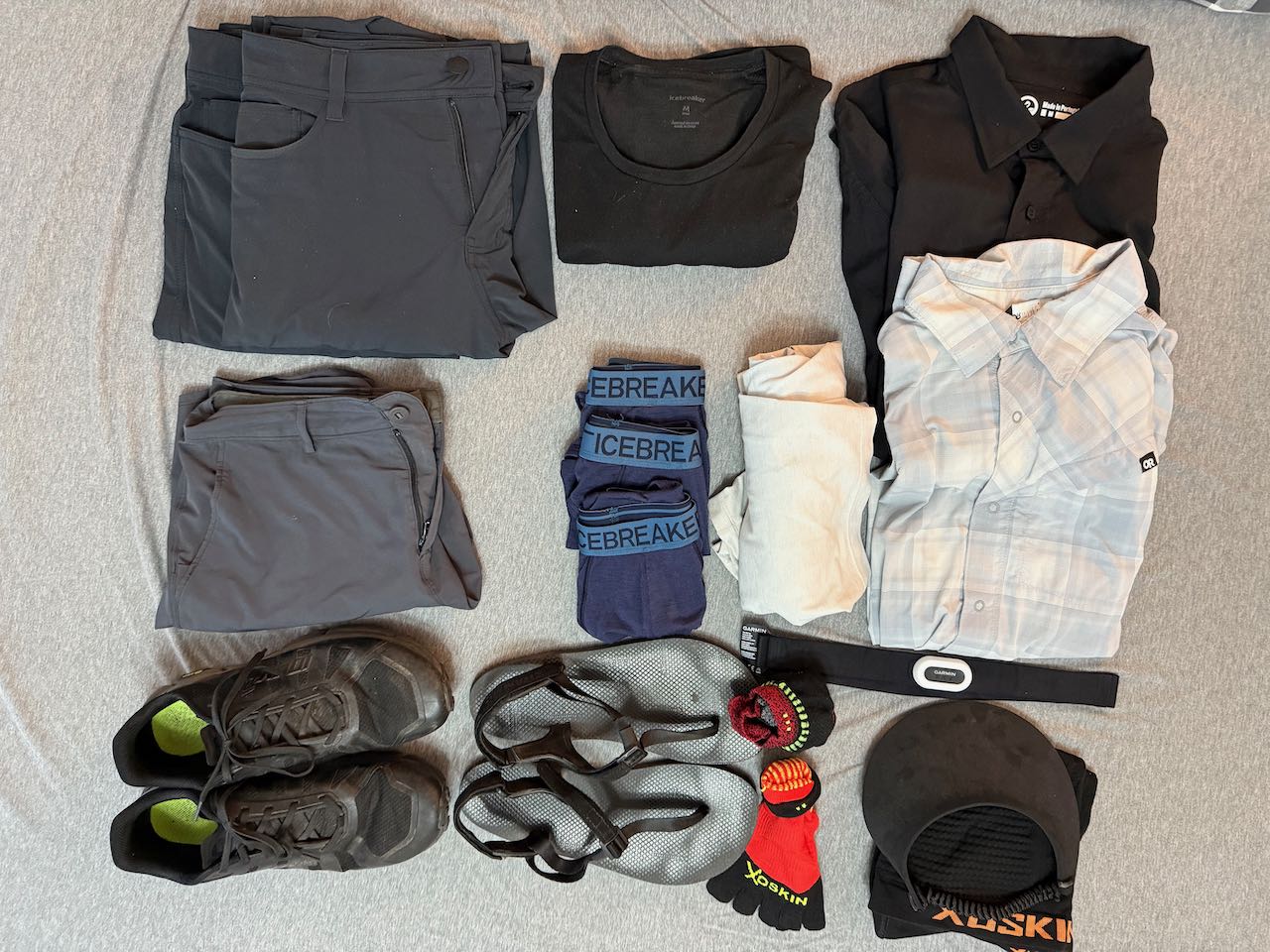
    I have notes about selecting clothing for an active life which goes in detail  about how I select clothing for a wide range of activities and conditions. I often engage in wilderness backpacking and exercise daily which typically includes a run. In normal circumstances my clothing dry overnight after being washed and then squeezed with a towel to jumpstart drying. The following items have been acceptable in every circumstance I faced in the last five years.

    • Outdoor Research Ferrosi Transit – 2 pair (2023/2024) Acceptable looking in urban settings while providing good mobility. Dries in a few hours and are comfortable in hot weather. I have some concerns about long term durability… noticed some light pilling near my knee after around 120 days of wear but only noticeable when my eye is inches from the fabric. Time between washing required varies between 1 day (muddy trails in hot weather) to 6 days (urban, low activity, cool temperatures). In cool conditions I will swap one pair of Ferrosi with a pair of Outlier Slim Dungarees which are more durable and better looking. Other good pants.
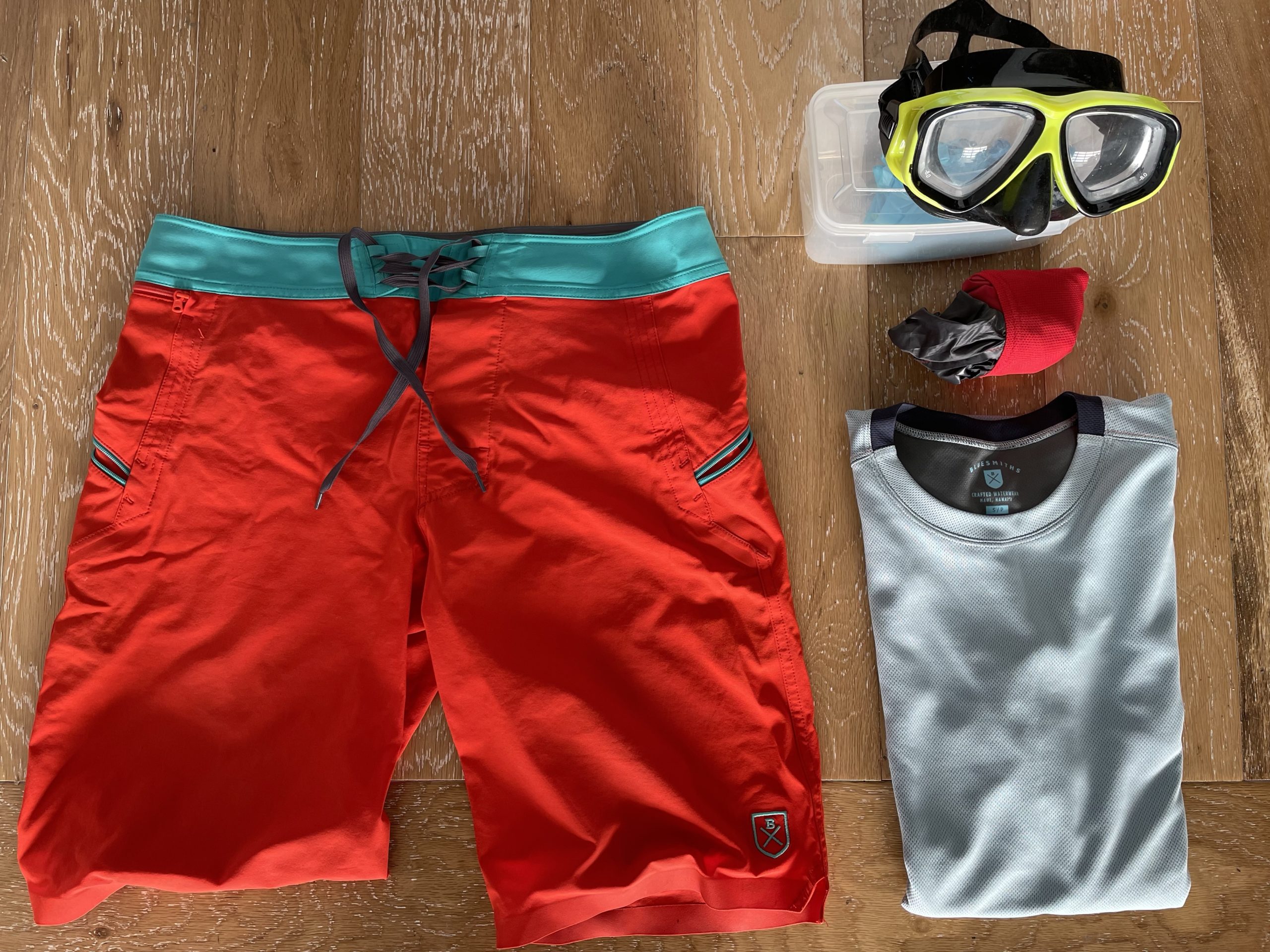
    • Patagonia Hydropeak Hybrid Walk Shorts (2023) dry in a couple of hours while hanging, faster when wearing. They are very comfortable, give me good freedom of movement. Not excessively “technical” looking. They can function as a swim suit, but if I am going to be on a beach for multiple weeks I will retrieve my Bluesmith board shorts described in the “beach section” below from as not to offend my wife’s sensibilities.
    • Icebreaker Anatomica Briefs – 4 pairs (2014/2021) the most comfortable underwear I have worn. They dry overnight and resist odor. I get around 600 days of wear before the waist band deforms and small holes appear. Only downside is that they bunch up a bit in hot weather when carrying a backpack. In the past I found the synthetic briefs from Ex Offico were pretty good but their quality has dropped. I have heard Uniqo Airism, 32 degree mesh, and Duluth Trading Buck Naked briefs are great, but no personal experience. When going light I bring two pairs: one to wear, one to wash/dry.
    • Icebreaker Anatomica Tee-shirt (2014/2021) merino wool with a bit of nylon for durability and a bit of lycra for a body hugging fit. This tee-shirt fits me perfectly, is super comfortable, doesn’t smell after a week+ of wear, dries overnight, and my wife likes how the shirt looks on me. UPF between 15-30? I get around 500 days of wear before an Anatomica Tee looks tired, and 600 days before the first small holes appear. This is my default shirt unless I am want something covering my arms (sun protection or warmth). I think Icebreaker makes the best merino tees, but there are a number of other good options from Smartwool, Outlier, Wool&Prince, and several other companies. While I love merino wool, there are advantages to synthetic technical-tees: absorb less water, dry more quickly, and are more cost effective because they tend to be cheaper and longer lasting.
    • Arcteryx Cormac Hoodie (2023) A casual UPF 50 shirt. Slightly textured which I find reasonably comfortable when I am hot and sweaty. When using a crystal deodorant resists odor for 3+ days of normal activities, 2 day of vigorous activity. Provides full sun protection. Resists stains pretty well so spills generally clean with a quick rinse, but after 130 days of use there were stains which won’t come out. Thankfully light stains on the heather mostly blend in. I found this shirt dries in less than 3 hours after being squeezed, rolled in a towel and hung in a cool indoor room with modest ventilation. When hung in bright sunlight it dries in less than 1 hour. Also dries in less than 1.5 hours when I am wearing it in moderate temperatures and humidity. This is my default shirt for “outdoors” / “athletic” activities. The Outdoor Research Echo is a good alternative for many: lighter, cooler feeling, with a slimmer fit, and good anti odor. Unfortunately for me, the Echo’s UPF is 15-20 has resulted in me getting sunburn when I spend all day outdoors in locations which have >10 UV Index. I have notes about other base layers.
    • Outlier AMB Merino Wool Button Up Shirt (2019) Very comfortable. Nice looking, resists wrinkles and if I don’t spill food on it can be worn for more than a week without washing. Dries overnight. Good air permeability, surprisingly comfortable in warmer conditions. My default long sleeve shirt when in urban environment. No longer made.
    • OR Astroman Button-Up* (2023) UPF 30-50, light weight long sleeve button-up shirt. Jack of all trades, master of none. If I could only have one shirt, this is what I would take. Good sun protection and reasonably comfortable in hot conditions, but not as comfortable as Cormac Hoodie. Reasonably dressy, but the slash pocket, tendency to wrinkle, and lack of fabric structure isn’t as dressy as a good wool, cotton, or linen button-down shirt. Resists odor for 2-4 days at “normal” activity levels, 1-2 when highly active. Dries in a few hours when hung up after washing. Carrying now because my wife doesn’t like me wearing clothing that looks the same every day and sometimes the versatility is useful.
    • Xoskin Toe Socks – 2 pairs (2022/2024) prevents blisters forming between my toes when walking or running for extended distances. I have worn one pair 30 days in a row doing ~20 miles of hiking each day without blisters. They weren’t stinky after six days of continuous use (and not washing) while backpacking in sandals, though they are more prone to pick up odor after several hundred miles of use or when encased in shoes. Gets ~700 miles before first hole appear. With darning can often make it to 1100 miles.
    • Shammas Elite Maximus (2024) I love the feel of running almost barefoot and the small space they take when packed. The Shammas replace a pair of Luna Venado Sandals which wore out after 1400 miles. I find the Shammas lacing system more comfortable and they have better traction than any Luna I have used, and they have better ground feel than Bedrock sandals… hoping they last as long.
    • Inov-8 Trailfly G 270 (2022/2024) Zero drop trail running shoe with a 12mm stack. Great fit for me: just enough room for my toes to splay while gripping my heel perfectly. Used for backpacking or trail running when the terrain is too challenging for my sandals or when I need to wear closed toe shoes. They have been acceptable footwear in snobbish establishments and no one has ever commented about them. I wear in transit and pack my sandals. The graphene infused soles are more durable than typical trail runners. At 1400 miles the uppers still look good and there is still a bit of tread on the highest wear areas of the sole. The V2 of this shoe reinforcements switched from a flat black are a shiny grey which makes them a bit less discreet. I have heard it claimed that Nike Pegasus Trail 4 might be even longer lasting though I am highly skeptical.

    Sports / Exercise

    • Garmin HRM-Pro (2021) gets higher accuracy during interval training than built in optical sensor on smart watches and works when swimming. Also provides running power which has been somewhat useful. Supports ANT+ and Bluetooth.
    • Foam Visor (2023) Keeps sun, rain, and sweat out of my eyes when running or hiking and doesn’t absorb water when worn in the rain. Typically combined with a hood which protects neck and ears.
    • Xoskin Compression Shorts (2023/2024) Great for many highly energy activities. Has eliminated chafing on long, hot runs, and of course work fine in less demanding circumstances. Ok as a swim suit. No pockets, but items placed on the leg are held in place by compression. Not durable enough to cycle in without shorts over them. When not subjected to extreme abrasive conditions, first hole appeared after around 600 hours of use, but performance is still good.

    Outerwear

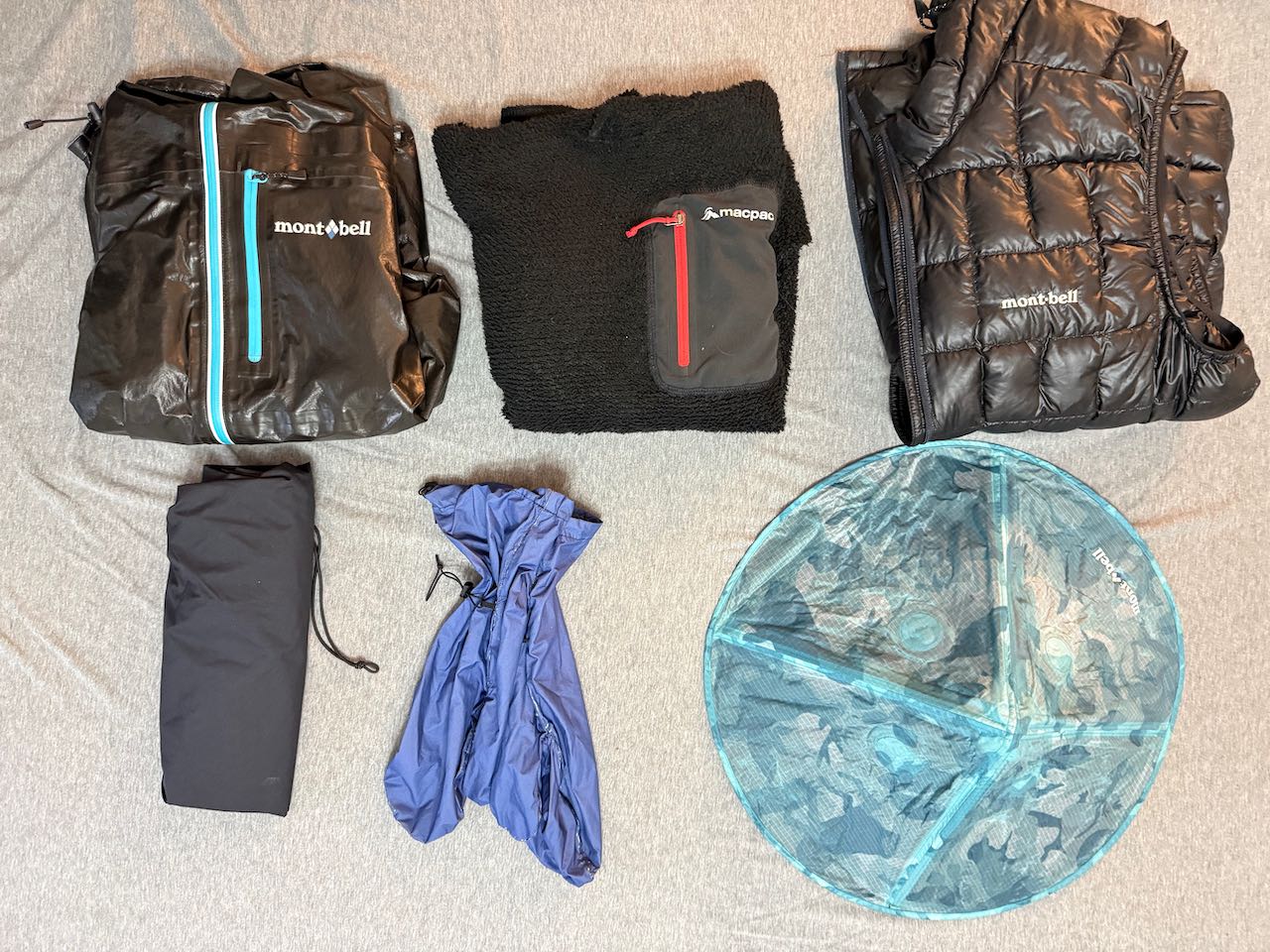
    The following clothing allows me to be comfortable at all actively levels when the temperature is 25F or warmer, and colder if I am engaged in high aerobic activities like running or cross country skiing.

    • Montbell DryPeak Jacket (2022) made from Shakedry. I can actually wear it and not be soaked by sweat when active! I have done zone 2 runs for 2 hours in 48F rain with just 1 gram of water accumulating. Waterproof and doesn’t wet out. Works well as a wind shell. Shakedry is somewhat fragile and is discontinued… hope something equally performant comes out soon. Other options are discussed in my post about rain gear.
    • Macpac Nitro Pullover (2021) Made from Polartec Alpha Direct (90gsm). Almost no water absorption and dries super fast. Very air permeable… I can feel air flow at walking speed in still air. Very light insulate without a shell, surprisingly warm under a shell. Great when active in cold conditions. Worn whenever my shirt isn’t warm enough. I am comfortable sitting in 68F wearing the Nitro and a tee-shirt, but when I pull up the hood and layer on a shell I am comfortable down to 40F doing light work (walking 2mph flat terrain), and in colder conditions when more active. Not as fragile as it looks but guessing 1/4 the lifetime of a classic fleece. There are lots of good options for an insulation layer.
    • Montbell Plasma 1000 Down Vest* (2021) Incredibly light weight vest which provides moderate insulation for my core. I have the Japanese version which has pockets. With a long sleeve shirt and shell I am adequately comfortable down to around 45F. When combined with a tee-shirt, Macpac Nitro, and a shell allows me to be comfortable while walking down to 30F. Combined with Nitro and Micro Puff keeps me warm enough in any winter conditions I am likely to encounter in the next few years. More acceptable looking over button down shirt / under blazer than my hoodie. Less than perfect for me: cut is a bit too boxy the neck doesn’t seal well.
    • Enlightened Gear Visp Rain Mittens (2022) Super minimalist protection for hands. Keeps my hand comfortable from freezing to around 50F when engaged in modest activity.
    • Montbell Umbrero Rain Hat (2021/2023) is a 1.8oz folding hat which fully shades my face, ears, and neck. It’s fully waterproof but still provides the best ventilation of any hat I have used. It deforms but usable in <25mph winds. I paint the inside for UV protection. I think it’s silly looking, and periodically have people point and laugh… but I have also received compliments and have had people chase me down to ask where they could purchase one for themselves. The tube inside the brim breaks after 2-3 years of everyday use. There are lots of other good hat options.

    Toiletries

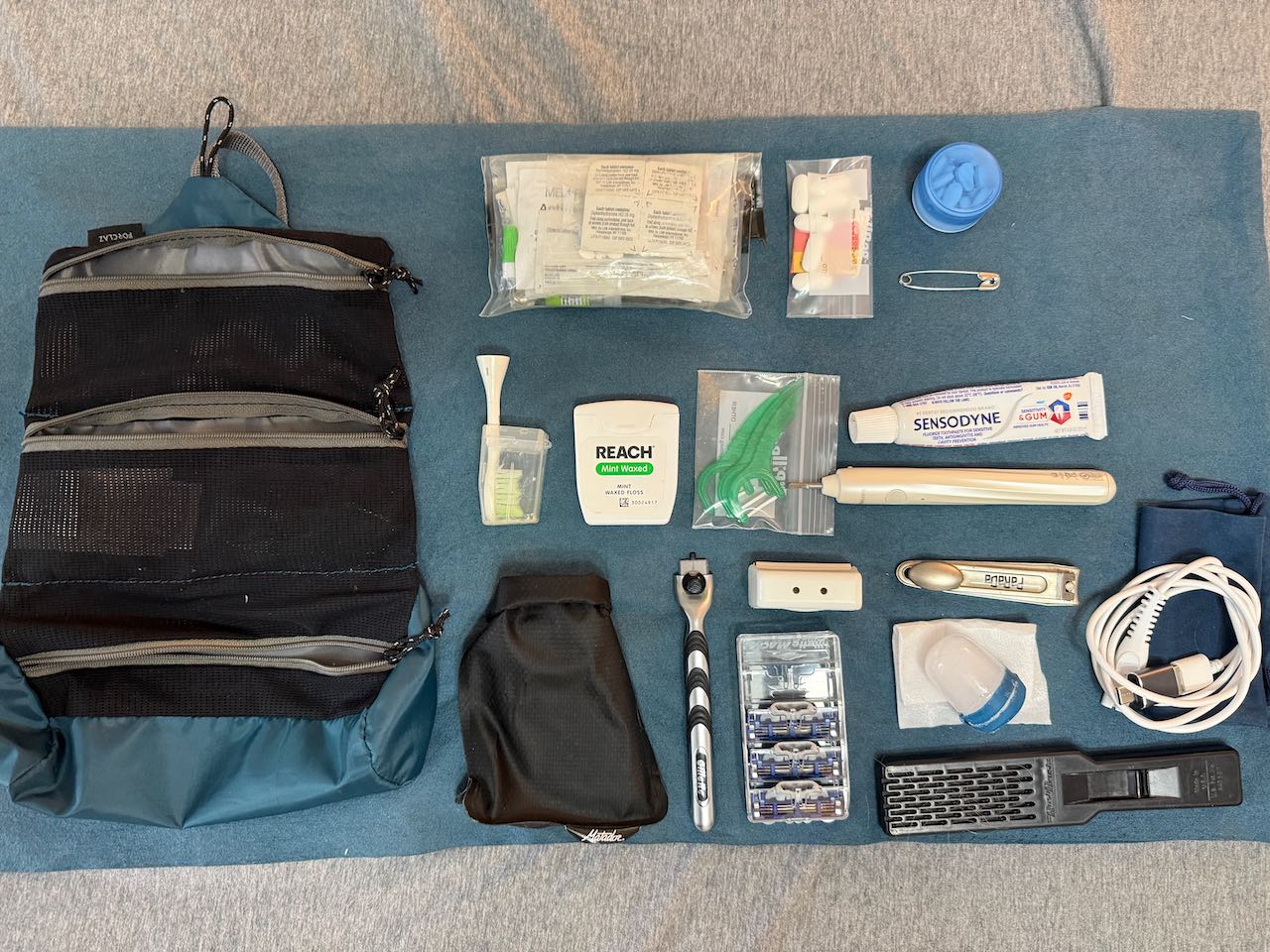
    • Decathlon Ultralight Toiletry Bag (2024) is the perfect size for my toiletry kit and make it easy for me to find everything quickly. Replaced REI Micro Shower Bag (2017) which made it hard to find what I was looking for. Top section holds first aid kit, middle things for teeth/lips, and the larger bottom section holds everything else.
    • First Aid Kit: Band-aids, single use benzoin tincture, compeed blister pads, antiseptic wipes, antibiotic cream, superglue, a couple of safety pins, and a few doses of nyquil and benadryl, small HumanGear GoTubb to store aleve.
    • Philips One Toothbrush (2024) Electric toothbrush that is compact, easy to use, comfortable in the hand, and reasonably effective. Use a full size Oral-B I am not flying to my destination. A charging adapter, though picture shows the original charging cable. Why doesn’t the Philips use a standard USB-C socket?!
    • Reach (rebranded Listerine Woven / Ultraclean) Floss (1996/2022) is the most effective dental floss I have used. Gentle to the gums while still getting plague and food wedged between teeth out. I believe it has been discontinued but still possible to find stock. My dentist has recommended coco floss as a good replacement though it’s more than twice as expensive.
    • Toothpaste and Toothpicks
    • 100senses body bar (2019/2024) which takes care of all my cleaning needs without drying out my sensitive skin or making my hair feel like straw. One bar lasts around six months. There are better shaving creams and detergents to wash clothing, but it’s been good enough and simplifies life for me.
    • Matador Flatpack Soap Case (2020). The Flatpak lets the soap dry out better than a ziplock bag, but it’s far from magical. In high humidity conditions I have had soap fail to dry after a couple of days. It doesn’t work very well as a case while showering.
    • Gillette Mach-3 Handle (2024) and enough blades (1999/2021) for my next trip segment. Use around 11 blades / year. Costco often sells large packs of the blades at a discounted price. The handle I have used since 1999 broke.
    • PaRaDa Nail clipper (2014) are large and heavy but effective and the trimmings catcher is brilliant. I have been saying for years that I will replace it with something lighter and more compact but I haven’t done it yet.
    • Retractable Bristle Hairbrush (1994) Compact and more effective than a comb for me.
    • Daily Medicine – not shown (2024) – Comprehensive preventative medical checkup in TW recommended some medicines to take daily.
    • Crystal Deodorant (2023) Simple Potassium Alum crystals. Years ago I ran an experiment and discovered if I showered regularly, no one could tell that I didn’t use deodorant. I suppose I have lower BO than some people. After >10 years I gave this deodorant a try after reading about them on /r/onebag. I notice that my shirts go a day or more longer before they pick up body odor. Carrying a 1.5 oz stick which shows little wear after 2 years of use. It’s best to apply right after a shower since it needs to be wet and works best on clean skin. It’s not an anti-perspirant nor doesn’t cover up existing odor. Rather it produces it environment that is hostile to the odor creating bacteria. Removed from case… rubber band to make it easier to grip.
    • A micro fiber cleaning / storage bag for my glasses
    • PackTowel Ultralight Body Size – discontinued (2009) Dries in less than 3 hours after I dry myself when hanging indoors, faster in sun, is compact, weights just 3oz. Large enough that I can wrap it around my waist like a small sarong. I found the face size sufficient for me to dry my body, but I am willing to carry a larger towel for the added versatility and ease of use. There are other travel towels.
    • I acquire sunscreen wherever I am. I try to select SPF >=50, considered very low risk for health, and reef safe when near the ocean. The sun screens in EU are way better than in the US because the FDA hasn’t approve some of the newer options. Such a shame since they are reportedly are safe, feel better on the skin, and often don’t leave you looking like a ghost. If the trip is short and I don’t have any sun screen from the EU left I will bring a Neutrogena Mineral stick. Around town where I don’t need to worry about form factor or TSA I will pick up whatever is the top rated sun screen that is liked by both consumerlab and ewg.

    Putting it Together

    Below is a picture of everything ready to be packed. Sandals, hat, and water bottle typically go in the side pockets, but can also be packed in the top of the bag if I need to put my bag in an airline sizer box. The bottom row goes into the bottom of the pack, vertically. On top of my clothing goes toiletry kit and outerwear. Top row is sometimes carried in the Decathlon bag, or sometimes laptop is inserted into my backpack, the Decathlon bag is packed in the backpack, and the other items go into the two zippers pockets of the Vagabond.

    Ready to Pack
    Packed with room left on top (will fit into a 16″ sizer). My packing list is what’s with me right now.

    Used When I Drive From “Home Base”


    Household Items

    The following are used whenever they can be easily transported to where we are staying for >2 weeks. If we are flying to a destination, they are stored in our car until we return. We also have a cooler and some kitchen tools and staples we have put aside for when we travel by car.

    • Tom Bihn Smart Alec (2022) durable bucket style day pack. Stands up by itself and is easily accessible through the top zippered opening without spilling. In this season of life this pack has two functions. When we are using planes as our transportation it is filled with the items I am not using, and is stored in the trunk of our car. When at home or at destination we drove to, it functions as my office storage. It is also the perfect size to hold two folding chairs and food for a picnic and works well as a grocery bag.
    • Oral-B/Braun 6000 Electric toothbrush (2016) and USB powered charger. A recent meta analysis concluded that the rotational approach of Oral-B is likely superior to approach of Sonicare, but both are significantly more effective than manual brushing and the electric toothbrushes like the Quip which relies on a brushing motion. Battery lasts less than a week now. Will need to replace at some point.
    • Pulse Flex Wireless Speaker (2017 & 2022) allows us to have synchronized whole house music and plays nicely with other BlueSound products and can be combined into a reasonable quality stereo system. We have the original Flex speaker and the updated Flex 2i. It also supports inputs via USB, Bluetooth, AUX, a number of streaming services like Spotify, and many free sites via URIs. Has a iOS and Android remote control app which works but has a somewhat awkward UI. Controls on the top let you select one of 5 user-defined “channels” without using the remote. I have the optional battery pack so it can be used outdoors. Sound quality is significantly less than KEF LS50 but better than most portable speakers, the speakers on our phones and the built-in speakers on TVs. When using them away from home primarily play lossless music which is stored on a thumb drive plugged into the back of the speaker. For most people I would recommend Sonos: for its lower price point, better streaming options, and slightly more processed sound quality which everyone but audio purists like me prefer. Even cheaper are products from Audio Pro.
    • Withering Body WiFi Scale (2014) makes it easy to track weight which is well integrated to Garmin, Fitbit, MyFitnessPal, LoseIt, and numerous other health tracking eco-systems. Body composition numbers not accurate. Having trouble getting it to switch WiFi networks.
    • ChiliPad (2019) which cools or warms water which flows through a mattress topper. I need to be significantly colder than Jackie to sleep soundly. When under our bed the heat exchanger not able to hit the cooling target, but it has been fine when sitting out. We tried an eightsleep system which much quieter but not worth the added cost to us. I didn’t find the automatic temperature adjustment of the eight sleep particularly helpful and the sleep tracking wasn’t significantly better than my Garmin watch.

    Variety “Travel” Clothing

    Extra clothing which is normally stored in our car during this season of nomadic existance, which is useful when we drive to a destination. Most of these items are not as versatile as what I carry with me all the time, but typically superior for specific conditions. When I am not space constrained they get added into my clothing mix.

    • Outlier Slim Dungarees – 2 pairs (2014/2019) High-tech nylon pants in the style of jeans. Gives me an almost tailored fit, looks great, good mobility and durability. Thanks to the NanoSphere treatment very stain and water resistant. Dry overnight. They are perfect when it’s <75F and I am inactive, <55F when active. When highly active and >70F the seam that runs along the inner thighs chafes. In hot weather prefer OR Ferrosi Transit pants. Over time the pants stretch out a bit especially around the knees which make them a bit less slim fitting. I get more than 550 days of use before there is any signs of wear: light pilling at the top of the pocket I use the most. I have yet to completely wear out a pair though I have retired a few pairs after a pen leak created a large stain and after I lost weight and needed to switch to a smaller waist. When paired with nice shirt, and blazer have been accepted in situations which called for semi-formal dress. The hiking pants I wore in the past couldn’t do that. I have repeatedly had women say “Where did you get those pants? They look great. I want to buy a pair for my husband.” SD seem pricey but it depends what you compare them to. When considering the cost / day of wear ($0.07/day)… they are 5x the cost of mass market nylon pants which don’t fit me that well, 2x the cost of higher quality nylon pants from companies like Prana and Patagonia, and about the same cost per day as Levi 501 jeans if you retired them when the knees are blown out. Maybe an indulgence, but I don’t think them as a luxury item when I see $1390 nylon shorts from Prada. Current pairs I am wearing were acquired in 2017. They are going to be discontinued. If you want a pair, buy them now.
    • Outlier New Way Shorts (discontinued) 2 pairs – (2014/2017) are nice looking shorts which fit me perfectly, are durable, and resist stains. The first place place for wear to show up is the mesh to drain the pockets develop holes. These shorts feel like they were tailored for me. I can’t put into words how “right” they feel each time I put a pair on. The fabric is thick enough to prevent items in my pocket from really standing out. They are pricy but I hadn’t found any shorts that I liked as much. They can function as a swim suit but aren’t ideal for that use because they take 2x times to dry as some of my board shorts and my wife observed “they don’t look like a proper swim suit.” Still wearing the first pair I purchased.
    • Minus33 Mid-weight Merino Mock Turtleneck (2023) Purchased for cooler days when I want something bit more casual than button down shirt but dressier than a hoody. Warm enough that I don’t need a sweater when it’s cool, but not overly warm when sitting around indoors. Have been able to wear for more than a week with no noticeable odor retention.
    • Patagonia Cool Daily Hoodie (2022) Comfortable hoodie, resists odor for 4 days when somewhat active, provides moderate sun protection which I believe is good enough when I am indoors much of the day or in locations with moderate UV index. Patagonia removed any UPF claims because between their initial testing and production the UPF performance dropped / was inconsistent (from >50 to 17-45, average 34). Use when my Cormac hoody is dirty.
    • Second Icebreaker Anatomica Tee-shirt in grey which is typically used for high intensity exercise.
    • Darn Tough Socks – 2 pair (2013/2019) are unsurprisingly durable since they come with a lifetime warranty. Icebreaker and the Smartwool PhD line are good alternatives. Worn out and replaced 2 pair of the no show light socks after >4000 miles of use for each pair. None of my light crew have been worn through yet.

    Lives in Car

    I leave some items in car trunk in case we encounter unexpected conditions. I rarely use these items personally, but have often loaned them out to friends who weren’t prepared for the weather we encountered.

    • Gossamer Gear Vagabond Packable (2021) 23L pack which is comfortable to carry and easily packs away in my larger bag. This is by far the most comfortable carrying packable day pack I have ever used. Most packable daypacks feel like a sack with straps designed to fit a non human.
    • Tilley LTM6 Hat* (2014) durable hat that provides good sun protection. I prefer the LTM8 which has more ventilation. Replaced a 20 year old canvas Tilley that was lost on a river trip.
    • Icebreaker Quattro Hoodie* (2012) is a medium weight merino wool sweatshirt. After several years of near constant use starting to pill and is a bit stained, so has been “retired” to the car.
    • ArcTeryx Squamish Wind Shell* (2012) is a 5oz windshirt with an air permeability of ~30 CFM. When combined with a heavy base or light middle layer provide comfort over a huge range of conditions. Comfortable against the skin. Best replacement would likely by the Mountain Hardware Kor.
    • Montbell EX Wind Shell (2023) Weights just 56grams and easily fits in my pants pocket. Provides decent wind protection while still being fairly breathable. Used for done in a day activities that have no risk of rain.
    • Patagonia Micro Puff Hoody (2020) Keeps me comfortable ~25F lower than I would be without the jacket. Provides just the right insulation for me for winter nights in the SF Bay Area and shoulder season backpacking in the sierras. Combined with down vest or Nitro Hoody it’s just right for winter trips in the sierras. Reasonably light and compressible. Long enough to cover my blazer.
    • Keen Clearwater CNX* (2014/2018) are the lightest sandals Keen makes. The toe cap has been effective at protecting my toes. When worn with gray socks they can “pass” for shoes most of the time. Keens ground feel is a bit “dead”.

    Backpacking Gear

    I have a 3-season packing list which makes use of a number of the items on this list and has several items which are specific for backpacking. I have not taken pictures of any of these items. The “winter gear” is not used “at home” because the Bay Area never gets cold enough to need these items, but they are pulled out when traveling to winter destinations. These are stored in a old Coke crate in the garage.

    • Hanchor Tufa (2023) 40L pack which weights 26oz and carries up to 22lb with great comfort, usable up to around 27lb. I found it more comfortable than the HMG SW2400. When the rolltop is fully cinched down qualified as carry on for most airlines. When lightly packed has passed for a personal size item, can scrunch into many personal bag sizers. Beautifully made. Most of the body is 100D PC so highly water resistant without the risk of delimitation.
    • Osprey Ultralight Drysack (2021) Used as a liner to protect against rain, can be used to wash clothing on trips if I am sharing a bathroom and can’t soak my clothing in the sink, and as a giant “clothing packing cube”. Sometimes used to separate dirty from clean clothing.
    • Gossamer Gear Whisper (2023) Ultralight shelter for one person which weights 9oz. Uses two hiking poles to stay up, and 7 stakes. Has bug netting around the perimeter, and you provide your own floor (I typically use polycro). Provides bug and rain protection for typical 3 seasons use, 2.5 above treeline? Lots of room with easy access and exit.
    • Durston X-Pro 2 (2022) Ultralight shelter for two people that weights 20oz. Good performance for 3+ seasons. Used it in moderate snow without problems. Easy to set up provided there is a flat space. Footprint in a bit larger than some 2-person shelters. Large vestibules. Very easy to use.
    • NunatukUSA Ghost Quilt (2003). 16oz, comfortable to 30F, have comfortably pushed it down to 15F when wearing my clothing and outerwear. This is the second version of one of the first backpacking quilts commercially made. A bit narrower than more modern quilts with a tiny footbox which I like because it makes it easy to ventilate my feet when I get too hot.
    • NEMO Tensor All Season Insulated Pad (2023). 13oz. Warm enough for me to use down to 10F. More comfortable and less noisy than NeoAir pads I used I’m the past. Replaces an Therm-a-Rest NeoAir UberLite which repeatedly develop leaks.
    • Trail Designs ULC Caldera, Gramcracker esbits Stove, MLD 850ml Pot. (2009). 4.5oz cooking set which fits inside the pot. Easy, efficient, compact. Couldn’t ask for something better, except the Tri-Ti version which can burn wood as well as esbits and alcohol.
    • HydraPak 28mm Water Filter (2023). 2oz, can push more than 1l / minute through it with modest pressure. So little pressure is required that I can actually use it inline between a water bladder and a hydration tube. Attaches to SmartWater and Platypus water containers. Huge improvement over my old filter whose flow requires much more force as it has been clogging. Just remember to give it a good soak if fully dried out before the next trip, otherwise you will have very slow flow for around 60 minutes during the first use.
    • Garmin InReach (2020). 3.5oz. Satellite communication device. Can send an SOS and do short 2-way text messages. Take on solo trips when in locations without a lot of human traffic so my family doesn’t worry about me. I have found it works with tree cover and in most canyons, but in these conditions will often take 30-45 minutes to get a message out or receive messages. There were time it did not work in a slot canyon. Much faster when it have a broad view of the sky. Can be using with a smartphone, or the numeric pad on the device.
    • Patagonia Terrebonne Joggers (2023) Very light weight polyester pants which provide a good range of motion, are very light, pack up small, UPF 40. Dry in less than 2 hours when hung indoors, less than 1 hour when wearing after being completely soaked in a rain storm. Very breathable and comfort in hot weather. Downside is that the pockets are a bit shallow so items fall out when sitting down.
    • Patagonia Cap 3 Tights (2007): added to my legs when facing continuously below freezing conditions.
    • Outdoor Research Meteor Mitts (2004): which have a removable 300wt fleece inner mitt which folds back to let you use your fingers and a durable, waterproof shell. Can use the shells without liner when it’s warmer. The magnets on the inner mitt detract from overall comfort. Many people replace the liners. Dries faster than all-in-one handwear.
    • Buff PolarBuff (2003) Generally I use the hoods on my garments, but sometimes I want extra insulation for my neck or head.
    • Manzella Power Stretch Touch Tip Gloves (2023) Light weight gloves that I can mix/match with shell mittens. Hands have been ok Visp mittens down to 20F.
    • Traction Devices* (2020): Gives trail runners and other shoes grip on snow and ice. Picked up when we were facing icy trails in Grand Canyon without footwear with sufficient traction. Don’t remember the brand and it’s not stamped into the chains. When doing a lot of winter trips I would use screw shoes.
    • OR Gaiters: (<1988) for keeping snow out of shoes/boots and the lower legs most dry.
    • Hostel sleep system: 48″ x 62″ piece of Polartec Alpha Direct 4004, 120gsm (2022) compressible warm blanket which is a $20 piece of bulk fabric, MLD Bag Liner (2023) 3oz 10D nylon sleep sack, in a Sea2Summit 2.5L Ultra-Sil Stuff Sack (2022). For stays in basic hostels and alberques that don’t provide bedding of any sort. Comfortable for sleeping down to 55F. The sack is snug but not too tight, keeping the blanket well positioned when cold. As it warms move blanket to outside of the sack or remove completely. Blanket can be warm like a shawl during particularly cold days. I will likely get a bigger piece of alpha direct, add a head slit so it can be worn as a poncho and get a larger sleep sack if I am regularly staying in the dorm style hostels.

    Stored during our travel (2022-2025?)


    Bicycling Gear & Clothing

    • Specialized S-works 2019 Roubaix (2021) an endurance bike that smooths out the road making it easy to be confident on less than ideal road surfaces with a responsiveness that approaches the Cervelo R-series. A huge improvement from the 2013 version of the Roubaix. Fitted with an Infinity Seat (weird looking but the most comfortable seat I have used), 2 water bottle cages, and a small seat bag which holds a pump, tubolito, bike tool, and 2 tire levers. I have a charger for DI2 which is powered via a micro USB cable gets used every month or so. Otherwise it sits in the garage.
    • Cervelo R3* (2013/2015). Replaced with identical bike when my first was stolen. Comfortable enough for an endurance ride, responsive like a race bike, great for climbing. Wore out drive train which has now been mostly replaced… still looking for Rotor chain rings. Now primarily lives on a Kickr for indoor “rides” and is my “spare bike” and if my Roubaix is out of action or an out of town friend wants to go for a ride.
    • Felix BC21R Bike Headlamp and Cygolite Hotshot Pro 150 (2019) The BC21R uses a removable 18650 rechargeable battery. I don’t love the Felix but it’s getting the job done and the swappable battery is very handy.
    • Power Tap P1 Pedals (2015) because I like objective measures. No longer made. The Garmin Rally pedals use standard Keto cleats, and are lighter.
    • Bicycling Shoes (2013) with cleats for PowerTap peddles. No idea the brand.. they were the cheapest shoes I found at a local bike shop. They are near the end of their life, but I haven’t found a shoe that is as well ventilated so I continue to squeeze a few more miles out of them by regluing the seams.
    • De Soto Mobius Tri Shorts (2018/2021) Can be used forcycling, running, and swimming. They used to be comfortable for all the activities I engage in when the temperature is above freezing. For many year reduced issues with chafing, dries fairly quickly, and are reasonably comfortable when wet. They have side pockets large enough to hold some nutrition and my phone so I don’t need to use a special cycling jersey. I get around 1000 hours of use from each pair before the elastic no longer provides any compression. Never had a pair develop holes. For many years I loved using these because I never need to think about what to wear for vigorous physical activities…. I just grab a pair of tri-shorts. Recently I have been chafing on my male parts when running in hot conditions so now not used for hot weather running.
    • Xenith Delta Shirt (2021/2022) is the most comfortable shirt I have worn when sweating heavily. The shirt maintains air permeability and doesn’t stick when wet. The shirt dries at the perfect rate: faster than wool or cotton, but slower than classic “fast dry” shirts, and feels cool against the skin. I have also found that is it the most odor resistant synthetic shirt I have tried, though not as good as wool. Only UPF 30. Use a ArcTeryx Cormac on longer rides.
    • Black Diamond Alpine Start (2021) is a 6oz hoodless ultralight soft-shell which is very air permeable (30-60 CFM depend on who did the measurement… feels like 45cfm to me) and extremely water resistant thanks to the Schoeller NanoSphere treatment. Very comfortable in high wind <60F doing normal activities, bicycling at tempo pace (~220watts / ~18mph) when it’s <55F or doing a zone 2 HR runs when it’s <50F. In a light rain find it easier to manage moisture than a Shakedry shell because the higher air permeability helps me dump heat (reducing the amount I sweat) while resisting the rain. Normally I like a hood, but the lack of a hood is useful when cycling and running with a hat. Windshirts are great!
    • Pearl Izumi P.R.O. Barrier WxB Cycling Gloves (2021) Keep hands comfortable on rides when it is cool and maybe wet. Cheap thanks to a clearance sale at sierra.com. Likely better gloves but they are getting the job done.
    • Giro Air Attack Shield Helmet (2013/2016) provides protection, good ventilation while having a streamlined aerodynamic profile. Has snap on optical shield. On my second Air Attack helmet due to a crash which broke the helmet but protected my head. If you ride a bicycle, wear a helmet!! I have been able to walk away from at least two accidents thanks to the protection of a helmet. Helmets don’t lead to more injuries due to a false sense of security. These days there are helmets which are more aerodynamic than mine, and also cheaper while providing equivalent protection.
    • Wahoo Fitness Kickr (2013) is a trainer for when it’s not convenient to hit the road. Integrated power meter and variable resistance which can be controlled via ANT+ or BlueTooth. Very useful if doing structured training based on power.
    • o2Trainer – not shown (2022) Working on improving my breathing. Not used enough to have an opinion.

    “Variety” Clothing

    While I normally like to wear my “uniform”, I know my wife likes variety in my clothing, and likes when I get “dressed up”. I sometimes call the following my “Jackie clothing”. All of these items can be rolled over their hangers and be stored in a $4 Ikea Frakta Duffel (2022) along with my beach items and stored “replacement” clothing items.

    • Toni Richards Hawaiian Shirt (2019) Everyone needs at least one shirt for “Hawaiian shirt day” though some might argue that white and blue with sharks rather than flowers isn’t very Hawaiian. I find the cotton lawn fabric used by Toni Richards to be one of the most comfortable materials when it’s hot and humid. Alas, UPF is quite low.
    • White Cotton Button-up Shirt* (2012) Was my default when I want to wear something more formal than a tee-shirt. Appropriate in almost any setting. Shirts which have more sun protection and dry more quickly have replaced it.
    • Muji Black/Grey/White Checked Button Up Shirt* (2013) for something that is casual but a bit more dressed up than my tee-shirt or hoody. Gift from Jackie.
    • Western Rise Unlimited Button Down* (2022) Blue Merino / Polyester blend button down shirt. My wife tells me it also looks like it was just ironed as it comes out of the my pack. Reported to be UPF 40. Fairly air permeable, resists odor, comfortable in a wide range of conditions. Dries quickly enough to hand wash at night and be ready to be worn the next morning. Can wear 4 days without any odor. It’s a great shirt for “urban” use.
    • Wool and Prince 210wt Burgundy Oxford Shirt* (2020) Slim fit, classic oxford cloth look while being 100% wool. Christmas present.
    • Banana Republic Purple Merino Wool Sweater (2013) for cool days or when some color is called for. Purple is the color of royalty… so it can function as a Christmas or Easter sweater. Gift from Jackie.
    • Grey Cashmere V-neck Sweater* (2019) for fall and winter evenings when I need more warmth than just a shirt and my hoody is too casual. Love cashmere but durability is low, it pills very quickly.
    • Boss Blazer* (2014) for dressy events in the fall and winter that don’t require a formal suit. Have found that it doesn’t wrinkle when packed carefully in my backpack while traveling between locations. Christmas present.
    • Bluffworks Hopsack Blazer* (2022) Blazer which doesn’t wrinkle, can be washed in a machine, and is light enough to wear in hot weather. If the Bluffworks Telex model existed when purchasing a travel blazer, I would have purchased it rather than the Hopsack.
    • Boss Wool Suit (2012) slim/european cut in super 140 wool. Fits me perfectly though not bespoken. First suit that I wear rather than the suit wearing me. Light enough that it’s usable in the summer. I use it for weddings, funerals, and special nights out on the town. I won’t naturally choose to wear a suit, but sometimes it’s appropriate.
    • Alpaca Blend Socks* (2021) are soft, warm, and cushioning with non slip “dots” on the bottom.
    • Vivobarefoot Gobi II (2017/2022) are comfort, zero-drop, minimalist ankle boots which look good with casual clothing or dressed up in a suit. I have used them around town, hiking in the backcountry and even run in them. Sending my original pair to be resoled after walking more than 1500 miles. With an occasional brush and polishing the uppers still look good after repeatedly soaked in rain storms, covered in mud, etc. Unlike shoes with breathable nylon uppers, keeps sand and dust away from my feet and socks. They are generally not needed given current dressing standards, I can typically get away with trail runners.
    • Softstar Zen Moccasin* (2021) Comfortable slippers for cold days.
    • Ultrafino Santa Fe Hat* – not shown (2021) is “Panama” straw hat. Alas, this hat’s weave is so tight that the ventilation is minimal, and the brim isn’t large enough to consistently shade my face and neck. The function of this hat isn’t as high as I expected, but I have held on to it because it’s a great looking hat that I will sometimes wear to a party when the UV index isn’t too high (like early evening).

    Beach / Water Clothing and Gear

    When we spend extended time near a tropical beach these get pulled out.

    • Bluesmith Spartan Board Shorts* (2016) For days that I am living in swimming suit, going in an out of the water. These shorts dry very quickly. Could use my other shorts if I was trying to minimize more.
    • Patagonia R0 Longsleeve Shirt* (2022) UPF 50 shirt for water activities. Tight fitting, dries quickly. Jackie approved. Picture has my retired Bluesmith shirt rather than white R0.
    • Matador Pocket Blanket* (2019) to sit on when at the beach.
    • Matador Droplet Wet Bag* (2019) which holds items on the way to the beach, and wet items on the way home.
    • Yeesam Prescription Snorkeling Mask (2019) which lets me actually see underwater life when snorkeling rather than just blurs and flashes of color!
    • Akona 2mm Neoprene Socks – not shown (2019) Prevent my toes from getting ripped up when using flippers. Sometimes used with sandals if I am constantly going in and out of water or with my cycling shoes if doing an extended ride is cold rain.
    • TYR Corrective Optical Performance Goggles not shown (2012) so that I can actually see when I am swimming in pools.

    Sentimental Items

    There are a several items I have kept as a specific way to honor people I love or past experiences.

    Box which I store these things, my spare glasses, some old documents, etc.

    • Various buttons collected over the years related to projects or movements that were important to me.
    • Libby’s pins (<2000) of a nativity scene, a mother and child. Originally worn by Libby on special occasions, they became daily decorations on the hats she wore during chemotherapy. They remind me of Libby’s courage and the two things most important to Libby, family and Jesus.
    • Gumby (2011) which was given as a reminder that when life is difficult, we need to be flexible.
    • Dad’s (<1980) tie tacks and Alox Swiss Army Knife which remind me of his love of the outdoors and his care for his students.
    • Knit Cap with 23andme logo (2016)
    • CatBus Plushy (2018) given to me by Jackie. It reminds me of the gentle film My Neighbor Totoro. I wanted a real CatBus, but no one can find one for me 🙂
    • Computer Wizard’s Tee Shirt (1977) from high school group club… still fits. Not shown: 23andme Tee-Shirt (2016) Hashicorp Cycling Jersey (2021)
    • Grandpa’s Yamaka (<1980)

    Stored – Replacement Clothing

    These items will be pulled out when my current clothing wears out. Most of these items were purchased on close-out, on sale, lightly used. A few were purchased at full price when I realized an item was “perfect” for me, and there was a risk that I won’t be able to repurchase due to the model being discontinued or changed by the manufacturer. A few of the items were used for time, and then I decided to drop the number of items I have in a weekly rotation so they were sent to storage. It’s useful to have have an unused items purchased at the same time as one which is in “heavy rotation” to see how much wear and tear accumulates over time.

    • 1 pair of outlier slim dungarees (2019)
    • 2 outlier new way shorts (2014-8)
    • 2 western rise evolution pants (2022)
    • 2 icebreaker tee shirts (2018-2021)
    • 1 arcteryx cormac shirts (2023)
    • 3 pairs of icebreaker briefs (2019-2021)
    • 6 pairs of darn tough socks (2015-2019)
    • 2 pairs xoskin socks (2022)
    • GoreWear R7 trail running jacket (2020/2022)
    • 1 Montebell Peak Dry Jacket (2023)
    • Macpac Nitro hoodie (2022)
    • 2 delta tee-shirts (2022).

    Stored – Possibly Retire

    • Tom Bihn Passport Pouch (2022) Small pouch which is large enough to hold my passport, phone and everything that might be in my pockets when passing through security checkpoints. In high crime cities I wear it under my shirt. Haven’t needed it.
    • Entchin Fanny Pack (2020) Inexpensive fanny pack which is a good size for half day activities. Can hold a headlamp, mini first-aid/emergency kit, water bottle, a protein bar, and small volume jacket. Use rather than daypack so my back is ventilated. The bucket has broken three times and is being held together by tape. Looked at a bunch of much more expensive fanny packs, but not work as well. Closest was the REI Trail 5 but when I put my water bottle in a holster it gets in the way of my arms as they swing.
    • Gossamer Gear Gorilla (2012) An older version of the Gorilla which I used when doing multi-night backcountry trips or urban travel when I am carrying more weight / volume than appropriate for the Vagabond. Its weights just 28oz, comfortable carries up to 25lbs for tens of miles in a day, has survived thousands of miles, and works as a carry-on bag. My size L is actually 23″ long, but has been able to fit in airline sizers and overhead luggage bottom in first if not overpacked and placed at an angle. Sidenote: The first generations of the Gorilla carried pretty well, the current generation connects the frame directly into the hip belt which has been stiffened compared to the first generation improving it’s carry characteristics. Likely being replaced by Hanchor Tufa which is more carry-on friendly and as comfortable to carry up to 22lb which is the most I typically have.
    • REI Swiftline Running Shorts Shorts* (2022) are very light shorts which dry quickly and pack down into a tiny space. Useful for running, working out in the gym, and as sleep wear. They can be used for swimming in a pinch. Over the years I have purchased these sorts of minimalist shorts, used them a bit, ultimately sold them because they weren’t being used, only to re-acquire a pair. I now know to store these away until the next time I think they would be a good idea.
    • Patagonia Capilene Thermal Weight Hoody (2009) for cool/cold weather outdoor activities. Without wind protection the grid weave lets air flow through speeding the release of heat. With a shell it provides some insulation. Comfort down to 30F when running without a shell, below that with a shell. When walking around town keeps me comfortable down to 45F when combined with a wind shirt with hoods up. I am reasonably comfortable engage in high energy activities when it’s 65F by fully opening the zipper and pushing the sleeves up to my elbows. Dries amazingly quickly and feels more comfortable than any other shirt I have used when it’s wet in cool conditions. Mine was actually called Capilene 4 because it pre-dates the renaming to “thermal weight”. Likely retire because light base + macpac alpha direct hoody is more versatile and has better performance.
    • Castelli Light Arm Sleeves* (2021) and Leg Sleeves* (2022) UPF 50 sun protection I combined with short sleeve shirt and shorts to avoid hassle of sunscreen. When in direct sunlight, limbs actually feel a bit cooler than when uncovered. Using the Arcteryx Cormac hoody so don’t need arm sleeves.
    • CoolNet UV Buff* (2022) Protects my neck and ears from sun and also functions as a headband to keep sweat out of my eyes. A set of magnets made to “pin” race bib to a shirt keeps the buff from riding up and exposing my neck. Often using the Arcteryx Cormac hoody so don’t need any more.
    • HiFiMan RE800 Silver IEM (2022) Light weight, good quality sound which doesn’t completely cut me off from my environment. Used when I want to listen to music without disturbing family. Great deal at $90.
    • Apple iPad Air 4 + Smart Keyboard Folio + Magic Keyboard for iPad (2021) Purchased as a second monitor (via Sidecar) for MacBook for when I am working away from home. I have found the iPad also works well for consuming media. The Folio keyboard is compact making it compact for onebag travel, but the keyboard feel is mediocre and not stable enough to use on the lap. I tried to do most of my “personal” computing on the iPad with a Magic Keyboard to see if a iPad could replace a laptop: it was a failure. There is too much friction integrating information from several windows and often the app experience on the iPad fell short when compared to the experience on a real laptop or Chromebook. This is my third iPad since they were first introduced. While each was useful for a particular task, I have yet to find it a compelling device for general use. A portable UCB-C powered screen is more effective for me as a second screen. I have mostly abandoned using the iPad. Jackie tried and gave up on “live on it”. Lives in garage for when exercising using Kickr and is taken to meetings when I want to take notes and a laptop would be too intrusive.

    Retired

    • Carots Shoes* (2017) are formal looking zero drop shoes. These are the only minimalist shoes I have found that looks like traditional dress shoes (heels and and tapered toe). They are sufficiently comfortable for an evening, but I won’t want to walk or stand for an extended period of time. My Gobi II are formal enough for any events I am likely to attend in the future.
    • Luna Oso Flaco Sandals (2022) I can walk 25 miles / day for a week on hard surfaces and my feet are still feel good. Has decent ground feel and pack very compactly. Good traction on trails. The wings are must more convenient that the “traditional” lacing. They irritate the side of my foot when I run without socks (fine for walking). Bedrock Sandals are very similar. I find Shammas sandals more comfortable. Worn out.
    •  Tommy John’s Air Briefs (2022) are really wedgy-proof and dry very quickly except for the waist band. Lost in a washing machine.
    • Radsome EarStudio ES100 (2018) bluetooth/DAC/headphone amplifier allows me to use wired headphones with devices missing a headphone jack. Can also function as a USB DAC. The ES100 is tiny, with decent sound quality (though Chord Mojo is better) and can even drive Sennheiser HD800 to reasonable sound levels. Not in situations that require a BlueTooth receiver or improved sound quality over the earphone jack.
    • AWS AC-650 Digital Pocket Scale (2012) a small scale which makes it easy to weight food on the go.
    • Kindle Oasis (2019) Lets me carry the majority of my library and every book can be displayed with large print for my aging eyes. Love being able to quickly search for notes / highlighted passages. I miss physical books and I know knowledge retention is better when reading paper books, but the convenience of the ebooks outweighs this for me. The Oasis ergonomics allows reading with a single hand and I like the warm backlight in the evening. I have been tempted by e-paper Android tablet such as those made by Boox which are a more versatile devices.
    • Rudy Project Ketyum Frames with Transitions DriveWear manufactured by Sports Optical* (2021) provides excellent protection for my eyes while cycling and any other daytime activity. Ketyum is one of the few wrap around frames that can handle a prescription as strong as mine. The lens are thick but not too heavy. Transition lens work well during daylight but are a bit too strong at dusk.
    • Trailbum Gnu Rain Cape (2023) Ultralight 3.5oz rain protection. Nice because it protects me and my pack. I wrote up a description of using this poncho combined with a piece of polartec alpha direct as a poncho liner. My wife “stole” it.

    Do not lay up for yourselves treasures on earth, where moth and rust destroy and where thieves break in and steal, but lay up for yourselves treasures in heaven, where neither moth nor rust destroys and where thieves do not break in and steal. For where your treasure is, there your heart will be also

    Matthew 6:19-21
  • Classic Systems Papers

    Many of the ideas that drive today’s “innovations” trace their origins to the groundbreaking work done in before 1990. Back then resources were scarse so people had to think and work harder than we do today.

    I strongly encourage people working on computing systems to read classic systems papers. These are papers that first introduced key ideas that have shaped our understanding of computing and often illuminate fundamentals more effectively than later papers.

    Technologies come and go, but foundations, core principles endure. Understanding the fundamental concepts ensures long-term adaptability and relevance in a fast changing world. I have found that reading classic papers has enabled me to reason from first principle and saved me from learning many lessons “the hard way.”

    My Reading List

    I was asked by some students for a list of classic system papers. Unfortunately the lists of papers I made for previous classic systems reading groups aren’t in my possession. So… the following is a list of papers I made this afternoon by harvesting my “outbox”. These are the papers that I have most frequently recommended to people in email. Sometime later I will update this page with a more carefully curated list of papers which will also include some more recent papers such as MapReduce and Attention is All You Need which I consider classic, even if they were published in the 21st century :). I am sure there are important topics not covered below, but this can be a starting point. Ordered by the frequency I sent them, not by importance.

    Other People’s Classic Systems Papers List

    Reading Groups

    I have been part numerous “reading groups” which focused on “systems”. The participates would identify both classic and current papers  they thought were important. Just making the list together was instructive and often led to a spirited discussion. Once we made a list of papers we would make a schedule that listed which papers were going to be covered and who was going to lead the discussion.  We would typically met once per week, often over lunch. Everyone in the group would read the designated paper.

    For a more complete set of guidelines, see How to Lead a Technical Reading Group by Cathy Wu of MIT. I am sure there are other good materials out there about reading groups.

    Related

    Are there papers that changed your perspective or have been foundational to you as a software engineer, systems designer, etc? Drop me a note because I would love to read it and potentially add it to my list.

    “Instead of standing on each other’s shoulders, we stand on each other’s toes”. – Butler Lampson, quoted Hamming

  • Church Essentials

    The book Dominion traces the very mixed history of the Christian church through history. When the church emphasized caring for the marginalized, humble service, and freedom for the individual it has been a force for good. When the Church cared more about its institution than the people, removed people’s freedoms through authoritarian decrees, and worst, when it pursued political power, things went very badly. This is my attempt to identify the most essential factors people should keep in mind when thinking about church. Summarizing what I have learned about “church” over the last forty five years is like trying to tame a hydra… as soon one head (topic) is addressed, two more pop up. 

    TL;DR

    • Church is not optional: You aren’t going to find a perfect church, but get involved in a church that allows you to build a community of love and draws you closer to God.
    • God and his grace is the heart: The start, end, and middle of the church is God’s amazing love, His grace toward us. It’s God who initiates, and we respond. A great tempted of humans is to go our own way, to try and be self sufficient. It’s so tempting to become religious and judgement. We need to resist this.
    • God is the head, not human leaders: Don’t let human created rules, programs, initiative, etc step on people. Leave room for the Spirit to lead and grant individual freedom to respond to what God is calling them to. When a church becomes authoritarian and/or pursues power: especially political or economic power, things go badly.
    • Everyone is important: The church is to function like our body, each person has a unique and valuable role to play. All gifting is important. Everyone should have a way to contribute to the church, not just “clergy” / “staff”. No one should be marginalized. People who have been marginalized by society should be embraces and supported by the church.
    • Love is the measure: Put simply by Jesus: the world will know we are His followers if we are loving each other. The mark of a Christian, and the mark of a healthy church is one that is characterized by love and care.

    Church isn’t Optional for Christians

    I know many people today who have become disappointed with institutional churches. They see originizations driven by humans who hunger after power, money, sex, and/or fame. A place that uses fear to control people rather than love to empower.

    This is tragic… but Jesus doesn’t want us to give up. In John 13 He said the world will know we are His by the love we have for each other. The author of Hebrews urges us not to abandon the gathering together.

    Don’t give up. Find a local church you can be part of. The question I would encourage everyone to asks is  “What church is God calling me to in this season of life”? Don’t be constrained by things like denominational alignment, narrow theological orthodoxy, or a particular worship style.

    God and Grace are the Heart

    I am working on a separate post on this so just a quick note for now. God is the one who initiated our relationship with Him. We experience life because of His love and grace. He asks us to extend His grace to others. Since everything we have has been a gift from God, we have no room to be proud or judgmental. Ironically, and people become more serious about grace, they have a tendency to become religious, proud, and judgement. This can only be avoided by continuously engaging with God in our daily life. To seek to see the world through His eyes.

    God is the Head

    Too often members of a church, especially the leaders, forget that the church is God’s. It doesn’t matter what we want, what we think is best. The questions are:

    • What is important to God?
    • What does God want us to do?

    I have seen numerous churches lock in on a very particular theology, methodology, or program, and insist that this is “the way” to believe, to act, or orginize. Everyone is expected to “fit in”. While this can produce a very “efficent” and “effective” orginization… this is not God’s recipe.  It’s ours.

    Likewise, when a church become authoritarian, tries to impose it’s will into the lives of people, things will end badly… not matter how “good” what they are advocating is.

    Several things which help us live into the truth that God is the head of the church:

    1. Focus your attention and worship of God. Fall in love with, be amazed by God’s wonderous nature. Look to please Him, no one else.
    2. Major in the Majors.  Simply put, recogize what’s important to God and focus on those things, not on human created orthodoxy.   Learn the most important lesson from the parable of the prodigal son.
    3. Leave room for the Spirit to work. Grant people freedom to follow after how God is leading them. Don’t use a one size fits all program, system, etc. People who are living this way will exhibit humility. Those to are driven my their self will be arrogant.
    4. Remember that God’s law is written on our hearts. Cultivate a practice of seeking God, not of pleasing others. Be open to God’s leading.

    Everyone is Important

    I Cor 12, 14, and Ephesians 4 makes it very clear that the church is strongest when every person uses the gifting God has granted them to love and serve others. Leaders’ job is to equip and encourage every person to live into God’s calling, not to do all the “work” themselves, or to tell everyone else what to do. Likewise, we need to value everyone. There are people who are marginalized by society. They should be embraced by the church.

    There are several practical applications for this.

    • There need to be meetings / gatherings that are small enough that everyone can contribute using their gifting.  See notes about group size.
    • People who are marginalized should be embraced, welcomed, given a prominent spot “at the table”.
    • Significant roles must be availible to people who aren’t “on staff” or “clergy”.
    • The church leadership needs to value all gifts and roles in the church. Too often I have seen churches that placed excessive emphasis on numerical growth and focus on leadership gifts to the exclussion of the other gifts. Other church emphasis “power” gifts or speaking in tongues, even though Paul pointed out that there is no gift that everyone has.
    • The church needs to recognize that God gifts people, and calls them to service. There need to be opportunities for “grassroot” initiatives from people who aren’t “leaders”.

    The book The Spontaneous Expansion of the Church by Roland Allen looks at the growth of the early church. Roland argues that the church doesn’t need complex structures and systems to be effective. Rather the church needs to free its members to follow after God. Too often, church leadership trying to control what is happening and how it’s happening. This is a mistake. The church is a group of people who are together, trying to follow after God and responding to what they are learning. The work of George Patternson and others has applied this lesson to the mission field. I think the out of print book The Church Unleashed by Frank Tillapaugh did a great job explaining what this might look like in a “modern” church in America.

    Love is the Measure

    Put simply by Jesus: the world will know we are His followers if we are loving each other. The market of a Christian, and the mark of a healthy church is one that is characterized by love and care. This means loving each other and finding true unity through that love. This is a theme well explored in Francis Schaeffer’s short book The Mark of the Christian and is discussed in the book A Church Called TOV.

    If we care more about a narrow doctrine, a particular political or social issue to the point that we are hurting people, we are lost.

    I think one of the most telling things about a church is who feels comfortable attending. Is the church attracting people who are similar to the people who gathered around Jesus, or is the church gathering people who opposed Jesus such as the Pharisees.

    so that through the church the manifold wisdom of God might now be made known to the rulers and authorities in the heavenly places. This was according to the eternal purpose that he has realized in Christ Jesus our Lord. – Ephesians 3:10-11 (ESV)